left biblioblography

Tuesday, June 16, 2009

The It Crowd – Time For A Little Hilarity

A friend at my old job turned me on to this show titled the IT Crowd. If you’ve ever worked IT, it’s an exceedingly funny show.

Bit o’ back story for this clip. Jen (the Relationship Manager in the show) goes on a date with an utter dud. She tells her employee Moss to get  rid of the guy if he comes around the office (everybody works in the same office building). Problem is, Moss is seriously socially challenged, and has problems gauging lies. So he tells Bill Crouse (that’s the dud’s name) that Jen has died.

The following clip always makes me laugh till I cry. Every time.

Enjoy.

Read More...

Saturday, June 13, 2009

Allegories Gone Wild – More Xenubites In The News, And Some Good News Sprinkled In With Some Rogue Clambake

Cross posted @ God Is 4 Suckers!

Scientologyinternet

We all Wiki to some extent, do we not? (Personally, my favorite is Answers.com – it provides far more multiple cross-references to different sources than the wiki version, and besides, it provides some pretty nifty tools to add to your browser and right-click menu.) Now it can’t be considered a primary source, mostly due to the fact that anyone can go in and edit sections. (Hey, I’ve done it myself on occasion, mostly to correct egregious errors, like an old Wiki page for the Negative Proof fallacy that claimed that believers and atheists shared the burden of proof.) The honor system principle is much like the concept of communism – they’d both work well if people understood the concept of sharing.

So the latest news is that the Xenubites have officially been excommunicated from the Wiki site. I (of course) don’t agree with the author’s article for the most part – Scientology is a vicious viral meme, and should be treated with iron fists, no velvet gloves allowed. There’s  rumors that they’ll try to start their own Wiki (think Conservapedia, only a lot crazier with the martyr complex), but we’ll see.

Norway is considering prosecuting Scientology for fraud. Another smart nation, France, is also following suit (pun intended)

An online opinion survey released by the White House this week ranks legalizing pot, playing online poker and cracking down on Scientologists as far more important issues.

And (no surprise here) Axiom 10 productions is actually policing the wimps at YouTube, demanding that any videos unfairly persecuting providing incriminating evidence against their religion cult be removed.

And in other news (not necessarily good), there are now schisms in the cult, and there are actually splinter sects known as Free Zones (and the folks that belong to these are called…you guessed it, Free Zoners). So now I’m guessing it won’t be long before there’ll be a ‘No True Scientologist’™ fallacy making the rounds.

On a different note, there is now a Freethought Pedia – definitely worth a look see.

Till the next post, then.

Read More...

Wednesday, June 10, 2009

And Here I Am Again – And When Did I Get So Damn Old?

So last Saturday, June the 6th, I went and competed in another Wushu tournament. Three Gold medals and a Silver (I almost lost my heavy metal fan, and kept pushing my glasses back up my nose, which is why I placed second). And yes, I need to lose that weight, but I conveniently blame my hypothyroidism.

Still, pretty spry for an old guy, or so I keep telling myself…

Read More...

Monday, June 08, 2009

Lies The Christians Tell: George Bernard Shaw

I'm an atheist and I thank God for it. - Shaw

Deathbed recantations are especially obnoxious. Have you heard this one yet?

The science to which I pinned my faith is bankrupt Its counsels which should have established the millennium, led instead directly to the suicide of Europe. I believed them once. In their name I helped destroy the faith of millions of worshippers in the temples of a thousand creeds. And now they look at me and witness the great tragedy of an atheist who has lost the faith. – George Bernard Shaw

Do a Google on select portions of this quote (in quotation marks), and guess what pops up? You got it – religious websites decrying atheism. Closer inspection shows (surprise!) that not one of them ever cites the work this quote is from.

It took a bit of searching, but I double-checked the fact listed here, which states:

Evangelist and editor Homer Duncan has been instrumental in spreading this fraud. The words are actually from Act 3 of Shaw's 1932 play Too Good to be True. Shaw, incidentally, was not an atheist (Free Inquiry, Winter 1985/86: 37-38).

And sure enough – it is in Act 3, the character of the Elder, and I quote:

THE ELDER [rising impulsively] Determinism is gone, shattered, buried with a thousand dead religions, evaporated with the clouds of a million forgotten winters. The science I pinned my faith to is bankrupt: its tales were more foolish than all the miracles of the priests, its cruelties more horrible than all the atrocities of the Inquisition. Its spread of enlightenment has been a spread of cancer: its counsels that were to have established the millennium have led straight to European suicide. And I--I who believed in it as no religious fanatic has ever believed in his superstition! For its sake I helped to destroy the faith of millions of worshippers in the temples of a thousand creeds. And now look at me and behold the supreme tragedy of the atheist who has lost his faith--his faith in atheism, for which more martyrs have perished than for all the creeds put together. Here I stand, dumb before my scoundrel of a son; for that is what you are, boy, a common scoundrel and nothing else.

Shaw was apparently an atheist for a short while, but became a mystic, blathering about the ‘Life Force’. He also was something of a nut:

Shaw joined in the public opposition to vaccination against smallpox, calling it "a particularly filthy piece of witchcraft", despite having nearly died from the disease when he contracted it in 1881. In the preface to Doctor’s Dilemma he made it plain he regarded traditional medical treatment as dangerous quackery that should be replaced with sound public sanitation, good personal hygiene and diets devoid of meat. Shaw became a vegetarian while he was twenty-five, after hearing a lecture by H. F. Lester. In 1901, remembering the experience, he said "I was a cannibal for twenty-five years. For the rest I have been a vegetarian." As a staunch vegetarian, he was a firm anti-vivisectionist and antagonistic to cruel sports for the remainder of his life. The belief in the immorality of eating animals was one of the Fabian causes near his heart and is frequently a topic in his plays and prefaces. His position, succinctly stated, was "A man of my spiritual intensity does not eat corpses."

His political beliefs pretty much widen the eyes and drop the jaw:

Shaw asserted that each social class strove to serve its own ends, and that the upper and middle classes won in the struggle while the working class lost. He condemned the democratic system of his time, saying that workers, ruthlessly exploited by greedy employers, lived in abject poverty and were too ignorant and apathetic to vote intelligently. He believed this deficiency would ultimately be corrected by the emergence of long-lived supermen with experience and intelligence enough to govern properly. He called the developmental process elective breeding but it is sometimes referred to as shavian eugenics, largely because he thought it was driven by a "Life Force" that led women—subconsciously—to select the mates most likely to give them superior children. The outcome Shaw envisioned is dramatised in Back to Methuselah, a monumental play depicting human development from its beginning in the Garden of Eden until the distant future.

In 1882, influenced by Henry George's views on land nationalization, Shaw concluded that private ownership of land and its exploitation for personal profit was a form of theft, and advocated equitable distribution of land and natural resources and their control by governments intent on promoting the commonwealth. Shaw believed that income for individuals should come solely from the sale of their own labour and that poverty could be eliminated by giving equal pay to everyone. These concepts led Shaw to apply for membership of the Social Democratic Federation (SDF), led by H. M. Hyndman who introduced him to the works of Karl Marx. Shaw never joined the SDF, which favoured forcible reforms. Instead, in 1884, he joined the newly formed Fabian Society, which accorded with his belief that reform should be gradual and induced by peaceful means rather than by outright revolution. Shaw was an active Fabian. He wrote many of their pamphlets, lectured tirelessly on behalf of their causes and provided money to set up the The New Age, an independent socialist journal. As a Fabian, he participated in the formation of the Labour Party. The Intelligent Woman's Guide to Socialism and Capitalism provides a clear statement of his socialistic views. As evinced in plays like Major Barbara and Pygmalion, class struggle is a motif in much of Shaw's writing.

After visiting the USSR in the 1930s where he met Stalin, Shaw became an ardent supporter of the Stalinist USSR. The preface to his play On the Rocks (1933) is primarily an effort to justify the pogroms conducted by the State Political Directorate (OGPU). In an open letter to the Manchester Guardian, he dismisses stories of a Soviet famine as slanderous and calls reports of its exploited workers falsehoods. He wrote a defense of Stalin's espousal of Lysenkoism in a letter to Labour Monthly.

So Shaw was an anti-vaccinationist, anti-evolutionist, pro-Stalin socialist, a Lysenkoist, a vegetarian, and all-around blowhard. Good writer, though.

The video clip I’ve provided is worthwhile up until the end of Shaw’s speech: the rest of it’s ridiculous rhetoric (I’m fairly sure that Himmler didn’t cop any ideas off of Shaw anyhow).

So, no, he doesn’t qualify for the Profiles in Atheism (I usually don’t include folks who renege later in life), but he sure qualifies under Fringe Theories.

Read More...

Saturday, June 06, 2009

When Philosophy Fails: The Futility Of Utility

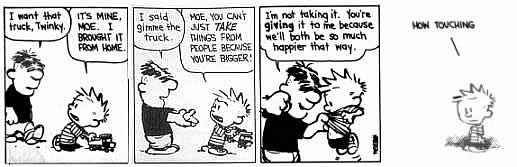
Cross posted @ God Is 4 Suckers!calvin_happy2

I have been made aware of Peter Singer and his utilitarianism, through blogversations with atheists and theists alike – I cannot say I approve enthusiastically. In fact, I’d go as far as saying I disagree, with a slight curl of the lip. Of all the –isms to choose from, I find this one less than satisfactory.

Just because I agree with his take on religion, is not an agreement in toto.

Utilitarianism:

Utilitarianism is the idea that the moral worth of an action is determined solely by its contribution to overall utility: that is, its contribution to happiness or pleasure as summed among all people. It is thus a form of consequentialism, meaning that the moral worth of an action is determined by its outcome. Utility, the good to be maximized, has been defined by various thinkers as happiness or pleasure (versus suffering or pain), although preference utilitarians like Peter Singer define it as the satisfaction of preferences. It may be described as a life stance, with happiness or pleasure being of ultimate importance.

Utilitarianism is described by the phrase "the greatest good for the greatest number of people". Therefore, it is also known as "the greatest happiness principle". Utilitarianism can thus be characterised as a quantitative and reductionist approach to ethics. It can be contrasted with deontological ethics (which do not regard the consequences of an act as the sole determinant of its moral worth) and virtue ethics (which focuses on character), as well as with other varieties of consequentialism. Adherents of these opposing views have extensively criticised the utilitarian view, but utilitarians have been similarly critical of other schools of thought. And like any ethical theory, the application of utilitarianism is heavily dependent on the moral agent's full range of wisdom, experience, social skills, and life skills.

Easily dissected, I cannot agree. As human beings (both on an individual basis as well as collective) have proven multitudinous times, the strong swim towards pleasure can often lead towards disastrous results. The sexual revolution, for instance, came about because of the ability to treat STDs like gonorrhea and syphilis with the pop of a pill (there are other reasons of course, but I consider that a primary). Decades later, penicillin-resistant strains of these poxes bedevil us still.

Singer is the foremost proponent of animal liberation:

In Animal Liberation, Singer argues against what he calls speciesism: discrimination on the grounds that a being belongs to a certain species. He holds the interests of all beings capable of suffering to be worthy of equal consideration, and that giving lesser consideration to beings based on their having wings or fur is no more justified than discrimination based on skin color. He argues that animals should have rights based on their ability to feel pain more than their intelligence. In particular, he argues that while animals show lower intelligence than the average human, many severely retarded humans show equally diminished, if not lower, mental capacity, and intelligence therefore does not provide a basis for providing nonhuman animals any less consideration than such retarded humans. He also points out that many primates have learned to communicate with American sign language (ASL) or symbol languages. These include chimpanzees, gorillas, bonobos and an orangutan. Primates that have learned ASL or symbol languages include Washoe, Koko, Chantek, and Kanzi. Likewise, pigs, birds, primates and cetaceans can rank as being as intelligent as children. Singer does not specifically contend that we ought not use animals for food insofar as they are raised and killed in a way that actively avoids the inflicting of pain, but as such farms are uncommon, he concludes that the most practical solution is to adopt a vegetarian or vegan diet. Singer also condemns vivisection except where the benefit (in terms of improved medical treatment, etc.) outweighs the harm done to the animals used.

I am foursquare and unapologetically a speciesist. Because of the commonality of biology I share with my fellow human beings, I will likely rate them higher on the value scale (there would be exceptions: people who would prey upon animals for the mere enjoyment may incite me to some level of anger, and devalue themselves). So I would still value a human being (mentally challenged) higher than a primate. I am not in favor of animal suffering: I see that as irrational.

Abortion:

Singer states that arguments for or against abortion should be based on utilitarian calculation which weighs the preferences of a mother against the preferences of the fetus. A preference is anything sought to be obtained or avoided; all forms of benefit or harm caused to a being correspond directly with the satisfaction or frustration of one or more of its preferences. Since a capacity to experience suffering or satisfaction is a prerequisite to having any preferences at all, and a fetus, at least up to around eighteen weeks, says Singer, has no capacity to suffer or feel satisfaction, it is not possible for such a fetus to hold any preferences at all. In a utilitarian calculation, there is nothing to weigh against a mother's preferences to have an abortion, therefore abortion is morally permissible.

Similar to his argument for abortion, Singer argues that newborns similarly lack the essential characteristics of personhood — "rationality, autonomy, and self-consciousness" — and therefore "killing a newborn baby is never equivalent to killing a person, that is, a being who wants to go on living."

I would go along with the first paragraph, but no to the second – again, my speciesist tendencies revolt. This is an evolutionary mechanism built into us. It is not the only yardstick. There is the potential future folded into the infant – it is a (non-supernatural) wonder waiting to blossom, a flowering of a new being…I could go on some rhetorical flourish, but the short version is I’d likely give my life to save a baby. Hard to argue with that, I think.

I have no argument with his stand on poverty – it’s sensible.

Zoophilianow I have an issue.

In a 2001 review of Midas Dekkers's Dearest Pet: On Bestiality,[35] Singer stated that "mutually satisfying activities" of a sexual nature may sometimes occur between humans and animals and that writer Otto Soyka would condone such activities. Singer explains Dekker's belief that zoophilia should remain illegal if it involves what he sees as "cruelty", but otherwise is no cause for shock or horror. However, Singer does not claim to endorse the views of either Dekker or Soyka, merely to be explaining them. Singer believes that although sex between species is not normal or natural, it does not constitute a transgression of our status as human beings, because human beings are animals or, more specifically, "we are great apes". Some religious individuals and animal rights groups have condemned this view.

This is a major problem – where one can indeed be too liberal. It may not ‘constitute a transgression of our status as human beings’, but regardless of the fact that we are animals, bestiality is rated as a mental disorder, and for good reason. An inability to form a sexual liaison with another adult, a frisson for something that’s not human, is decidedly abnormal. I am not committing the naturalistic fallacy when I state that animals are incapable of granting consent – so are children, because when it comes to human beings, either you can communicate, or you can’t. Silence as assent was bogus when Plato said as much, and it still is. And really, how many dumb animals can actually say no?

I would go as far to say – that the application of bioethics vis-a-vis utilitarianism lends itself to a breakdown of moral universalism (of which I’m a proponent). Consider:

It is widely considered that infants are a high value to any society at large, regardless of level (we shall grant this a high degree of universality, shall we?). It’s a survival mechanism to breed in numbers. By applying the above principles (i.e., giving animals a higher value rating than infants, despite the ability of the latter to develop cognition incrementally), we lose fundamental values we normally ascribe to potential moral agents. One might argue that the word ‘potential’ is meaningless, but we live in a society (and indeed a world) that is built on the concept of potentiality. Potentiality has value. “The children are our future!”, while somewhat trite and cliché, still stands.

The slippery slope is not my favorite specter to invoke -  I see it abused gratuitously on the internet. But there is merit in it sometimes. If we change the moral value of an infant in society’s eyes, it stands to reason the infant will become more abused. If we grant the non-human animal greater status than we grant our own children (a sentence that I personally never dreamed I would write or speak), then it is my opinion that we lose – both in the short term as well as the long term.

As to the zoophilia angles – well, I’m sorry, but there is such a thing as being TOO liberal. With the rising tide of pandemics (from the Avian flu to the Swine flu), this option is anything but viable.

Anyways, that’s my nickel’s worth. Flip it or spend it, it’s up to you.

Read More...

Thursday, June 04, 2009

How Creationists View Evolution

Funny as this is, the scary part is that the large percentile of creationists actually agree with this video.

Read More...

Tuesday, June 02, 2009

Who’s That Old Guy? Wait, That’s Yours Truly!

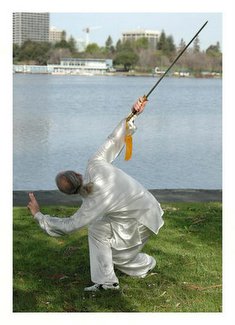
Last Saturday, I competed in another martial arts tournament. Yes, that’s me in the pony tail. The style I’m performing is Fu Style Tai Chi, created by Fu Zhen Sung, a Pa Kua master who created the style when he retired.

I always place with this form, and this is about the sixth time. I also brought home 3 other gold medals, and a Grand Champion plaque for my division.

It’s a little bit of all right. Funny story: right before I was ready to leave, my name was announced. I was confused, mostly because the last tournament, you had to enter 6 events, I only entered 4 in this one. Plus, I thought I had to pay extra (which I hadn’t). So I reported to the announcement table, and one of the people lugs over this HUGE trophy. I was agog. Luckily, it was a kid’s trophy (I don’t think the thing would’ve fit into my car anyways), and they brought the plaque over.

Am going to another tourney this Saturday – wish me good play, as luck’s got nothing to do with it (why do I hear a Tina Turner song in my head when I say that? Hmmm…)

Read More...