left biblioblography: quantum physics
Showing posts with label quantum physics. Show all posts

Saturday, June 28, 2014

More On The Madness Of Muslims–To Compel, Or Not To Compel?

Cross posted @ the Atheist Oasis
militant_atheistThis should be no surprise for anyone:

Saudi Arabia Defines Atheists as Terrorists

King Abdullah of Saudi Arabia has shocked many by announcing in a royal proclamation that under new laws, being an atheist and spreading atheist ideas is now a terrorist action. The Interior Ministry of Saudi Arabia has issued new guide lines about what exactly defines an atheist, which includes, “calling for atheist thought in any form, or calling into question the fundamentals of the Islamic religion on which this country is based.”
The changes in law have come, the authorities in Saudi Arabia claim, to prevent dissidence and unrest within the country and to better protect their law-abiding citizens. They are specifically to prevent protests and other actions that could “harm public order.” However, it is perhaps more accurate to say that there is concern within Saudi Arabia that their citizens are traveling to Syria to aid in the fighting there, and then returning with new ideas about how a government should interact with its people. The re-definition of atheist is thought to be an easy way of tarring the names of those that the government of Saudi Arabia wishes to remove and criminalizing anyone that has thought or speech that contradicts the government’s official positions.

The effects of these changes in law, however, are not limited to new arrests that may occur in the future. They also apply to those that are currently in prison in Saudi Arabia. This could greatly alter the resolution of cases against inmates that are considered dissenters by the Saudi Arabian government. On the other hand, it has been argued that in many legal cases, these new definitions have been used for a while to convict people of slight offenses.

Saudi Arabia is understandably concerned about terrorism. After all, eighteen of the nineteen 9/11 bombers were from Saudi Arabia. This move, however, has caused outrage amongst human rights groups, including Human Rights Watch, which monitors actions taken to limit the rights of citizens. The laws will merely aid officials within Saudi Arabia that are currently carrying out systematic campaigns of fear, intimidation, panic, and investigation of their own population.

Oh, fuck that.

Saudi Arabia is a foremost exporter of Wahabbi terrorists, and is a main financial backer for Al-Qaida. And they’re ‘understandably concerned about terrorism’? The KSA has a horrific record of human rights violations – let’s never mind they treat their women like shit.

The ugly fact is…until petroleum is rendered worthless, these crazy asshats are going to do whatever they please, because in our world, it is all about paygrade.

Till the next post, then.

Read More...

Friday, September 04, 2009

Science Fiction Where The Fiction Outweighs The Science – Eureka!

Eureka! is actually a TV show that I enjoy immensely. As the entry states:

Eureka takes place in a high tech community of the same name, located somewhere in Oregon—an address from the pilot indicated Washington, but all details since (state flags, maps, etc.) agree on Oregon—and inhabited entirely by brilliant scientists working on new scientific advancements that frequently go disastrously awry. Town is operated by mysterious private corporation called Global Dynamics, that supposedly is funded by United States government. The town's existence and location are closely guarded secrets.

U.S. Marshal Jack Carter stumbles upon Eureka while transporting a fugitive prisoner (his own rebellious teenage daughter Zoe) back to her mother's home in Los Angeles. When a faulty experiment cripples the sheriff of Eureka, Carter finds himself quickly chosen to fill the vacancy. Despite not being a genius like most members of the town, Jack Carter's ability to connect to others, his simple but effective ideas, and his steadfast dedication to his work repeatedly saves Eureka, and sometimes the entire world, from one would-be disaster after another.

It’s basically a good show – I rather like all the characters (including the exceptionally yummy Salli Richardson-Whitfield as Dr. Allison Blake and Erica Cerra as Deputy Jo Lupo), it’s got some semi-decent plots, and the writing isn’t all bad.

What IS bad, is the alleged ‘science’ writing. For instance, in the episode ‘Invincible’ an agoraphobic scientist becomes mysteriously imbued with supranormal (read superhero-ish) powers – as the explanation-exposition is fleshed out, one of the main scientists cites the ‘we-only-use-ten-percent-of-our brains’ rubbish. In ‘Blink’, an SUV is totaled by a scientist…who as it turns out, had some sort of formula for speeding up the metabolism in order to move faster than the human eye can follow – e.g., somewhere in the vicinity of 588 MPH. Uh, hello? The human body can’t do this sort of craziness – a good likelihood that the individual’s heart would explode long prior, and even if said individual could get up to that speed, the body in question would probably blow out all the joints, eyeballs, eardrums, and other sundry items not designed for that sort of duress. And of course, the tired old impossible canard of time travel. Jack Carter discovers the timeline has been tampered with, and goes back in time to stop it being tampered with – and anybody with the slightest knowledge of quantum physics knows that A. Time travel is impossible, and B. even if someone COULD do this, it would negate itself, becoming something of a quantum Zen koan on Quaaludes.

And, yeah, I get it that it’s a TV show. It’s actually a fun watch. I get it that it’s fiction. I just wish they would put just a teeny tiny bit more effort into researching the ‘science’ part, instead of just using stale formulas. It’s supposed to be about science, after all.

Just sayin’.

Read More...

Sunday, October 21, 2007

Allegories Gone Wild - Sucking At The Teleological Teat Of An Appeal To Wonder

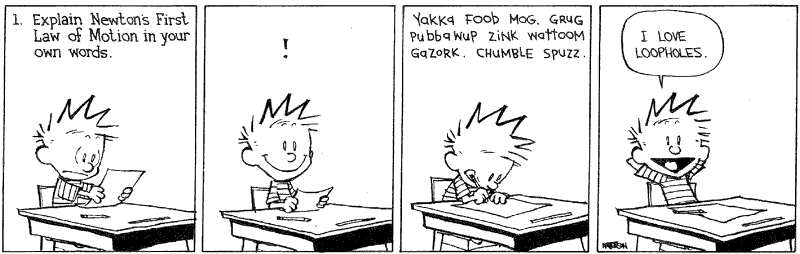
calvin-on-scientific-law

Cross-posted at God is for Suckers!

I ran across this little ditty, courtesy of Old Earther, Hugh Ross.

And it's...well, just a touch on the wild side.

Arguably the most hotly debated theory in physics is string theory, the concept that at the core of every fundamental particle resides a tiny string or loop of energy that vibrates in nine different dimensions of space.

Ummm...no, that's ten to eleven different dimensions. Yeesh, get it right before you spout off.

The significance of string theory is that if it or some other multi-space-dimensional theory of physics accurately describes physical reality, then religions that insist on a doctrinal construct of God and his dealings with humanity demanding no more than the equivalent of the dimensions of length, width, height, and time must be wrong while religions like Christianity whose entire doctrinal system fundamentally requires the equivalent of many extra dimensions could be correct.

Wow, so I guess anyone who's ever used the Akashic records must be on an equal par? Or howzabout the Hindus, or even the Buddhists?

Apparently not, as the next paragraph demonstrates:

Because Christianity among the world’s religions remains alone in its appeal to the equivalent of many extra dimensions and since humans can only visualize phenomena within the dimensions that they personally experience, the “could be correct” transforms into “the Bible’s words must be uniquely and inerrantly inspired by the One who created the universe.”

Many extra dimensions? Such as? Heaven and hell, and all that malarkey? That's like, two extra. Unless there's something I'm missing. Most likely, it'll be a string of scriptural verses (unsupplied in this article) that simply waffle on poetically about a certain deity, his 'wonders to behold'.

Any theory as loaded with theological implications as string theory is bound to be controversial. Such controversy should not be interpreted as implying that the theory is lacking in evidence. However, the greater the controversy, the more the need for evidence to overcome doubts about the theory. In that context, it is welcome news that theoretical physicists have demonstrated a seventh confirmation of string theory to complement the six that already exist.

Umm...the theory is lacking in evidence. In fact, most string theorists have no evidence to back up their assertions, because string theory is very lacking in evidence. Any evidence at all.

This seventh confirmation comes from a team of theoretical physicists exploiting a facet of string theory to explain what previously had been mystifying aspects of the Nernst effect (the crosswise flow of heat and charge currents in the presence of a magnetic field) in high-temperature superconductors. Specifically, they demonstrate how the physics of a black hole in negatively curved spacetime that includes an extra dimension of space produces a set of transport equations directly from quantum mechanics field theory that predict certain features of the Nernst effect.

All this is good and fine, but what does it prove, exactly?

String theory was invented to explain how gravity, general relativity, and quantum mechanics could coexist.

Correct.

However, until now, this coexistence could only be outlined in the broadest terms or used tor explain details that could not be directly observed.

Or predicted, or repeated.

By predicting from string theory an effect that can be observed in the world in which we presently live theoretical physicists have provided additional evidence that string theory indeed is the pathway to unify all of physics.

Ummm...this was in relation to the Nernst effect - where's this 'additional' evidence?

Such additional evidence translates into more evidence for the extra- and/or trans-dimensional doctrines that are unique to the Bible among the world’s great holy books.

So here's the nutshell: here's this unprovable set of theorems (they're interesting, I'll grant you that) that attempt to synchronize the apparent disharmony between gravity, magnetism, the weak and strong nuclear forces with relativity and quantum mechanics, and Ross here tries to mesh this with his untestable, unprovable theory (in his case, it's definition #6 of the word theory) in order to appear scientific.

Like it or not, this is the new battleground. Quantum physics, string theory, the saccharine shepherds will warp science to bring more 'lost sheep' into the fold. This is known as the fallacy of the spurious relationship, which is defined as "In statistics, a spurious relationship (or, sometimes, spurious correlation) is a mathematical relationship in which two occurrences have no causal connection, yet it may be inferred that they do, due to a certain third, unseen factor (referred to as a "confounding factor" or "lurking variable")."

 So gird yourselves for battle, with slide rules as swords and particle accelerators as artillery.

Questions?

Till the next post, then.

Read More...

Sunday, August 26, 2007

Believing In 'Nothing'...And Lo And Behold, There's Evidence Of Nothing!

Cross-posted at God Is For Suckers!

VoidWhereProhibited3 "If you look long enough into the void the void begins to look back through you." - Friedrich Nietzsche

No doubt, if you've been around the blogosphere long enough, you'll eventually hear that hoary old chestnut - "You believe in nothing." This is oftentimes followed by some trite vanilla monologue about how them thar nasty ole ay-thee-ists shore do make a big noise about sumpin' they don't be-LIEVE in, ow-huh! The inferred accusations are three-fold: A. if we don't believe in 'anything', why say anything at all, which becomes a twisted allegorical nod to on high, all in the speaker's own subjective opinion, and B. Please, become a casual secularist, stop talking about it, you're making me extremely uncomfortable, or C. Gee, you're so full of anger and hatred, who made you like this?

Fact is, I believe in humanity, I don't worship my species, thanks much for putting words in my mouth (PTUI!), I don't really worship myself (very much: obviously, I love the sound of my own voice, or I'd be that silent 'casual secularist' the religious loonies so yearn for), and I really don't want the world blown to bits over a few scraps of parchment found in a desert.

Now that the nutshell epistemology is over and done with, I present to you (with tongue firmly ensconced in cheek), that 'nothing' we're credited with 'worshiping':

Great 'cosmic nothingness' found

Astronomers have found an enormous void in space that measures nearly a billion light-years across.

It is empty of both normal matter - such as galaxies and stars - and the mysterious "dark matter" that cannot be seen directly with telescopes.

The "hole" is located in the direction of the Eridanus constellation and has been identified in data from a survey of the sky made at radio wavelengths.

Previous sky surveys that have traced the large-scale structure of the nearby Universe have long shown, for example, how the clustering of galaxies is strung into vast filaments and sheets that are separated by great gaps.

But the void discovered by a University of Minnesota team is about 1,000 times the volume of what would be expected in typical cosmic gaps.

"It's hard even for astronomers to picture how big these things are," conceded Minnesota's Professor Lawrence Rudnick.

"If you were to travel at the speed of light, it would take you several years to get to the nearest stars in our own Milky Way galaxy; but if you were to go to this hole and enter one side, you'd have to travel for a billion years before you would get to the other side," he told BBC News.

The void is roughly 6-10 billion light-years away and takes a sizeable chunk out of the visible Universe in its direction.

 Wow, so astronomers have found the Rub al Khali among the stars - bereft of all things. A hole in the heart of the universe. A large maw of absolutely nothing.

It beggars the imagination (mine, at least) - a void so vast, composed of an abstract of zero. Wrap your minds around that one, and get back to me.

This is the Apostate, signing off.

Read More...

Friday, April 27, 2007

Wrestling With The Eternal - A Brief Foray Into The Quantum Idiocy

AtomicSymbol

I recently had a bit of a soiree (more of a skirmish, actually) here, and it got ridiculous fairly quickly.

Fellow by the name of niran (interestingly enough, the name translates in Thai to 'eternal' - hmmm, sounds like a vested interest) - and it would be amusing, if it weren't so common in the blogosphere.

Came blaring on from another blog, laid out his premises, and when there wasn't an instant response, tried to derive victory from a lack of reply.

Typical.

From then on, said theist began trying to (what I call) dictating the premises.

Swearing was indicative of an inability to debate, he kept dragging out the Hilbert Hotel analogy, and began gloating at length about his 'triumph' (not that there was any to be found).

Most folks just walked away in disgust. He brought no evidence: he changed definitions to suit his purpose: name-dropped a number of atheists, and talked smack FOR them: all sorts of adolescent folderol.

Here's where he screwed the pooch:

Brilliant, no? Still want to continue this utterly unscientific tomfoolery? I'll try and say this politely. I've no problem with the conservation of energy. Your deductions however based on conservation of energy violate the law of conservation of matter. That means.... the deductions are wrong!! You said matter can be destroyed. If you read the above definition, you'll realise that it cannot. Name calling doesn't take away from the fact that your position is just plain wrong. It's just bad science, that's all. Pick up the pieces and fight another day mate. You've been destroyed.

Not only is the claim that I was 'utterly destroyed' bad form, but matter can indeed be destroyed. I did stipulate (several times, in fact) that energy can't be destroyed, but no matter (pun intended) how often I pointed out that the two weren't the same, this daft fellow kept equivocating like mad.

The only error I made (that I can tell), was that I tried to stay strictly within the bounds of thermodynamics, employing the KIS principle (Keep It Simple). So I began digging around elsewhere.

Surprise! I was right.

Witness:

"This leads to a different equation for continuum dynamics, as compared with general relativity. For a perfect fluid, this alternative dynamics predicts tenuous amounts of matter production or destruction, by a reversible exchange with the gravitational field. This exchange is completely determined by the dynamical equation and the scalar equation of the gravitational field. In contrast, the usual equation for relativistic continuum dynamics allows matter production only if some additional field is assumed, and the production rate must be phenomenologically postulated."

And:

"Matter can be created and destroyed in accordance to Einstein's equation E=mc^2.
This requires a re-think of the Principle of Conservation of Energy...
Energy can not be created or destroyed it changes from one form to another (which includes mass).
As for atoms having a life span, radioactive atoms certainly do have a life span, but non-radioactive atoms appear to have an infinite life... unless protons start decaying (http://en.wikipedia.org/wiki/proton_deca... but their half-life is approximately 10^32 years... some 10^22 times older than the universe."

Oh, and here as well:

"Physicist Charles Seife defines zero-point energy as: "The energy caused by the spontaneous creation and destruction of subatomic particles, even in the deepest vacuum. It is a prime suspect for the cause of the cosmological constant.""

Let's just never mind the atomic bomb, or perhaps any matter that enters a sun's corona, no?

Oh, and one more:

"Cosmic rays, he has time & again told the world, are born of the creation of matter in interstellar space. Last week in London, before most of the world's greatest physicists, Dr. Millikan was ready to admit, and did admit, that cosmic rays seem to be offspring of destruction as well as of creation."

I believe those four examples will be sufficient for now. I feel inordinately (but not insufferably) proud of myself, and I can rest easy, knowing that I put the kibosh on this nonsense.

Bis interimitur qui suis armis perit - He is doubly destroyed who perishes by his own arms. (Syrus)

Read More...

Monday, April 23, 2007

Opening The Doors of Misperception

(Crossposted at Gods4suckers.net)

(Due apologies to Aldous Huxley and William Blake)

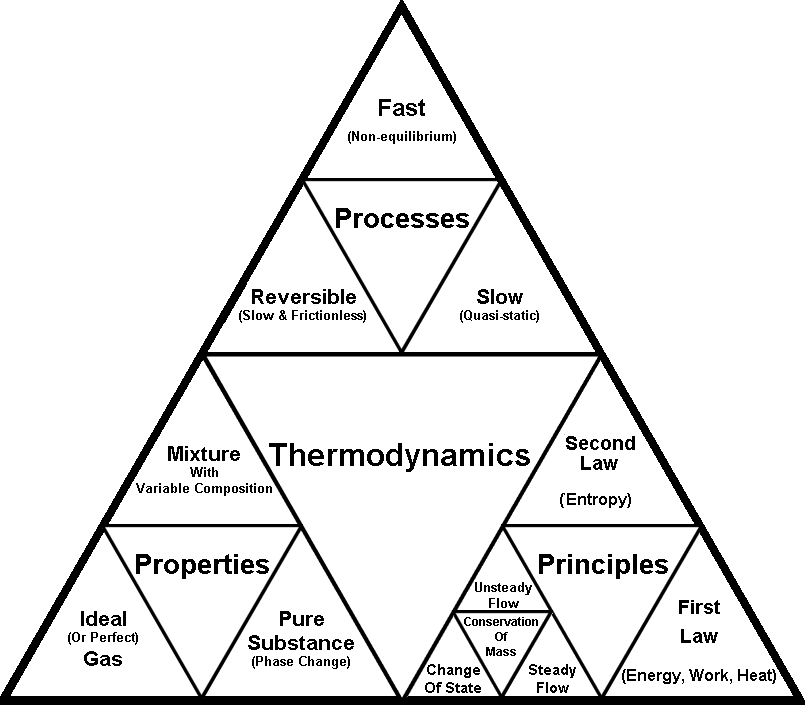
triangle

"If the doors of perception were cleansed every thing would appear to man as it is, infinite. For man has closed himself up, till he sees all things through' narrow chinks of his cavern." - Blake, The Marriage of Heaven and Hell

In some ongoing debates, I've noticed a distinct tendency on everyone's part to codify specific issues that seem to defy logic, i.e., quantum physics, thermodynamics, etc.

So this is directed at everyone - and hopefully, it'll set a few bulbs off, or refresh a memory or two.

When viewing specific topics (see examples given), our anthropic filters seem to befuddle us to no end. I have heard more than one mention that the 2nd law of thermodynamics doesn't seem to apply on a broader scale than our limited perceptions, for instance.

I say that no law is immutable, nor is it beyond breaking. This doesn't render the law violate: in a universe of flux, stasis is stagnation.

Here, I'll break it down to layman's (layperson's? Gah, I loathe political correctness!) terms.

Here in California (at least in my neck of the woods), the legal speed limit on the highways is 65 mph. If, however, you were to take a drive down I-880, you'll see innumerable instances of that law being broken. The law is still in effect. It's a matter of enforcement (though a black-and-white on the shoulder, writing a ticket, will indeed force other drivers to slow way down).

To take the simile further, if for instance, I don't own a car and/or have a CDL, the law is still in effect, but it doesn't apply to me in any way, shape, or form. I am, to abuse a phrase, above that particular law (or below, or outside of it, if anyone chooses to be overly pedantic about the bloody thing).

That being said, the other misperception we all labor under is one of straight lines.

Perfect example: in the ongoing debate of evolution vs. creationism, the latter inevitably takes the position that being human is the pinnacle of life, when in fact, evolution demonstrates that is simply not the case.

Another perfect example (one we are all prone to), is the straight line. Bear with me here.

Ever heard the phrase, 'Think outside the box'? I'm not overly fond of buzzwords or catchphrases, but cogitate for a minute. You never hear it as 'Think outside the sphere', do you? Why is that?

Because we are creatures of straight lines and angles. We have a system of counting by 10s (our digits: let's not get started on binary, octal or hexadecimal!), our limbs are lines, with angles at the joints. So just from this observation, we think linear. Sometimes, grudgingly, cyclically as well ('All nice things are round, like the universe and a baby's butt', as Chesterton phrased it so nicely).

So, springing from the basis of that observation, we tend to view things as a linear progression (point A to point B).

Then we hit the snags in modal thinking. When we observe something (say, like the 2nd law of thermodynamics), we posit an A-to-B sequence. When in actuality, the 2nd law sometimes doesn't go all the way to B, but stops halfway, and just sits there. In some cases, it'll actually go backwards. On the rare occasion, it'll skip B entirely, and go to point C (here, I will gladly take examples from the resident kibitzers - I don't doubt it happens, but an example can be found, I'm sure). At this juncture, many of us will scratch our heads, and say "What in the world...?"

Evolution's another problem, especially dealing with creationists (who are even MORE prone to this blinkered approach). I (almost) never tire of explaining to them that evolution isn't a linear progression: I compare it to a pool of observable phenomenon (yes, I know, a tree is a better example, and I'm striving to avoid the B-word).

In both circumstances, evolution and the 2nd law (sometimes) don't obey a set number of sequences. More to the point, while there is some predictability in either data set, there will be (and are) exceptions to the rule(s).

In the case of evolution, atavisms, and in the case of thermodynamics, gravitational interactions, for two examples.

So, to nutshell:

  1. Let's think non-linear (H.P Lovecraft's 'non-Euclidean' space-time continuums springs to mind), and
  2. Until the High Court of Quantum Correctness tosses out the laws of thermodynamics, I intend to abide by them.

"Exceptio probat regulam in casibus non exceptis" - “The exception confirms the rule in the cases not excepted.”

Read More...

Sunday, April 22, 2007

Nihilo Nihil Fit - More Fun With Thermodynamics

(Crossposted at Gods4suckers.net)

The theist's song:

"I got plenty of nothing
And nothing is plenty for me." Frank Sinatra, I Got Plenty O' Nothin'

The atheist's song:

"Nothing from nothing leaves nothing
You gotta have something to be with me
Nothing from nothing leaves nothing
You gotta have something to be with me."

- Billy Preston, Nothing From Nothing

Here's another flashcard - use it to your heart's content.

I've run into this nonsense on the 'Net more often than I care to - it's simply semantical wordplay, and really, fairly ridiculous.

We constantly hear this crap about the 'Uncaused Cause'. Or 'How did the universe pop into being?'

Sophistry is the word that comes to mind.

The Internet abounds with amateur armchair philosophers (I count myself amongst them) - as if the ability to regurgitate some stream-of-consciousness is validation in and of itself, like for instance, this clown.

I call him a clown, because he blathers on about the 'Uncaused Cause', with all the tired canards of stereotypes, and a witless ignorance of science.

I watched this debate unfold, and just shook my head. It's just too easy to debunk this.

So let's debone the red herring, and fry it up for tonight's dinner, shall we?

The First Law of Thermodynamics (aka the Conservation of Energy) stipulates that energy can't be destroyed - that it only changes. So, unless there's some scientific evidence to state otherwise, we will need to presuppose that energy is infinite in nature.

There - Herr Herring is now descaled. Now to fillet it:

As of May of last year (hat tip to Stardust for this one), apparently there was a contracting universe prior to this one.

According to some proposals, the Big Bang is a repeating cycle. Universes might expand, then shrink back to a point, then expand again. Thus the “bang” would be really more like a bounce.

So, infinite regress is back in the fold. Energy is infinite: the universe, not. Critical philosophers, rejoice!

There you go - science adheres to the complete opposite of exnihilation. Logic demands no less, and neither should we.

Newsflash: it's the religious who claim something from nothing.

And nothing's plenty for them.

Read More...

Wednesday, February 28, 2007

ANOTHER PUFF PIECE WRITTEN BY A PROFESSOR

Welcome to another episode of 'Things that get so far up my nose, it scratches my hypothalamus'.

A shout out to to KC at bligbi.com (who learned about it from Unscrewing the Unscrutable) for this one.

After my last tangle with an alleged 'professor' (of journalism, no less!), I gave it no more thought. Now we have a Professor of Law spouting off, and none too well, I might add.

Prepare to get somewhat incensed.

One of my best friends grew up in the Mormon Church. I asked Steve recently what he thought of Mitt Romney's statement that "we need to have a person of faith lead this country." Steve, unlike Romney, isn't an orthodox Mormon, but he's a very thoughtful person, who knows more about religion that just about anyone I know.

Fairly standard entry point: 'I talked to someone of faith'. Anecdotal.

[...]

Steve's view is that religious believers of every stripe all have something in common with each other that's relevant to issues such as who ought to be president.

It seems fair enough, that is, if you're a believer, that is.

But he's careful not to overstate the matter: he emphasizes that many Christian churches don't consider Mormons to be Christians, and that such disagreements aren't trivial. (A good rule of thumb is that differences of opinion of the sort that have led large numbers of people to kill each other are probably pretty significant).

People get violent over religion. Not really a newsflash.

Still, Steve believes - correctly in my view - that in general the differences between religious believers are less important than the differences between believers and nonbelievers, and that this distinction is and ought to be relevant to political life.

And here we go again. Best to skip over less important points, like say, who's qualified to hold an office? Watch as he makes a stilted argument on discriminating against atheists.

That belief helps explain why, for example, Americans say they are far less likely to vote for an atheist for president than for members of various groups (women, Jews, ethnic minorities) who have been excluded historically from presidential consideration.

It's called discrimination, my friend. Imagine the response if you denied someone office based race, sex, gender, or any other civil rights matters. (I'm not going to accept a 'gee, just shut up or change your mind' riposte, because that stinks of thought police.)

Now among liberals, the knee-jerk reaction to such poll data is to condemn the intolerance it represents. Yet I think there are good reasons for refusing to vote for an atheist for president - subject to the caveat that I also believe genuine atheism, like genuinely orthodox religious belief, is actually quite rare.

Aye caramba!!! Do any of these people bother do any research? Wait for it: he'll reveal an underwhelming source a little later on. Albinos are rare: will you deny them public office on the grounds that not only are they rare, they make people uncomfortable?

Of course there are lots of people who claim to be atheists, just as there are lots of people who claim to be orthodox religious believers. But how many people, at least among the social classes that produce presidential candidates, believe in the doctrines of Christianity with the same degree of confidence with which they believe in, say, the existence of Antarctica?

Wait: what? How lopsided is that argument? G.B Shaw wasn't too far off when he said, "Those who cannot do, teach." How is this germane? Answer: it's not. Social classes? Nice of him to admit there actually is a caste system in American politics.

Naturally it's considered quite rude to press people on such matters,

You can press me anytime, 'professor'. I don't find it rude: I know few 'genuine' atheists who do. Of course, it helps to beg off on doing any real research, by pretensions of courtesy.

but in my experience most supposedly orthodox religious belief, on closer examination, melts away into a vague sense of an ultimate moral order, supervised by an even more vaguely conceptualized divinity. (Among a lot of liberal Christians, this is asserted openly, to the point where they seem to adhere to a form of Christianity that excludes all specifically Christian beliefs).

I'd advise this cat to get out more. 'Ultimate moral order'? Good thing he doesn't teach philosophy.

Conversely, when one presses a purported atheist, one almost always finds that the person believes in various propositions that simply don't make sense without a belief in some source of an ultimate moral order, i.e., what most people would call "God." For instance, almost everyone who claims to be an atheist still makes lots of "ought" statements, as in "we ought to preserve biological diversity," or what have you.

Hold on: there's a vast difference between propositions and believing in some anthropic principle that rules unseen over the unwashed masses. The ultimate authority is Man, that's it. If you require an unseen cosmic baby sitter to refrain from plunging into feral chaos, I'd say that goes more to your poor upbringing and lack of self-control. Who has this guy 'pressed'? Anyone I know?

The latter view is that of the famed biologist Edward O. Wilson, in his new book The Creation. Written in the form of a letter to a pastor of the Southern Baptist faith in which Wilson was brought up, Wilson argues that atheists like him and religious believers ought to agree that preserving biological diversity, and therefore in the long run humanity, is a profound moral imperative.

And that's it. Sum total of his research is...drum roll please...one book! Let's not forget that this is a strawman (obviously) - I'm guessing that the book in question had a bit more...substance. This appears to be the be-all and end-all of his research. Chatting with a buddy and reading a solitary book on the subject. Wow, don't exhaust yourself, Professor.

Wilson is a brilliant man, but this kind of thing has always seemed to me nonsensical on its face. After all, the human race has existed for an eye-blink of cosmological time and will certainly cease to exist in another eye-blink or two.

This paragraph is just - eye-crossing. What is this supposed to mean, exactly? That we shouldn't give two rips of a rat's fart in a hurricane? Is this some weak jab at existentialism? Back-handed ad hominem, to boot.

The only response a genuine atheist would have to that fact is, so what? Which helps explain why there are almost no genuine atheists.

This is just pathetic. How much is this guy getting paid for this? I wouldn't give him 5 bucks to write this - hell, he'd have to pay me to accept the stupid thing. I write better articles for free, fer cryin' out loud. Obviously he's piggy-backing on the 'cold empty lives' stereotype about atheists. "Believe in nothing - why should I care?"

Bad news, prof: we're thinking, breathing, living human beings regardless of our un-belief. No one I know or have met (online or otherwise) is in any way apathetic - we still have passion, we are allowed to raise our voices in the ruckus, our fists to the skies, cry J'ccuse! or Kudos!, and many of us are deeply concerned, both with our fellow human beings as well as ourselves.

Because this is all there is. That's it. Best to make the most of it. Touch a heart, a mind, one another, breathe, laugh, cry, enjoy, and most of all, help each other.

And guess what? I'm the real deal. A genuine atheist. And there's a lot more out there than just little ol' me. A lot more. Fifteen to sixteen percent (give or take) of the US population. So we don't get a seat at the table? No political representatives? What happened to 'no taxation without representation'? Hey, didn't we fight a war over that?

And maybe, just maybe, if you attended a Beyond Belief convention, or a Western/Eastern Atheists Meet, or actually left the campus and looked for us, you'd find out just how wrong you are.

Welcome to reality.

Here's his email. Send him your indignant responses (note: DO try to keep it somewhat polite - we still have a major PR problem, ergo, we should at least try to behave with a modicum of decorum).

Paul Campos is a professor of law at the University of Colorado. He can be reached at paul.campos@colorado.edu.

And there you have it. Final analysis: rhetorical rigmarole.

Till the next post, then.

Read More...

Sunday, February 18, 2007

DUBITO ERGO COGITO - COGITO ERGO DUBITO: FIVE POINTS

"In the province of the mind, what one believes to be true either is true or becomes true." - John C. Lilly

This post was inspired in part by the Jewish Atheist, and partially from reading on the 'Net about some debate, where the theists and atheists had to switch sides, and the theists came up with the best arguments against belief, and the atheists had nuthin'. I'd link, but alas cannot find.

So, as a thought experiment, I will hereby take the other side. This pentalogy consists of items that make me doubt my atheism.

1. Saturn.

Not only does this planet sing, but according to Harlan Ellison, in his book Edgeworks - An Edge In My Voice, he says on page 42 when he was covering the first pictures transmitted from Voyager I (essay entitled Saturn, November 11th, date is 1980) of the planet Saturn:

"The Voyager was literally being shot at by Saturn as it flew past. The 'spokes' seem to be -- hold your breath -- enormous linear particle accelerators!"

On page 43, "And so these electrified ice crystals apparently discharge along the length of the spoke creating, in effect, the Solar System's largest radio antenna as well as a natural linear particle accelerator."

That we, as a species, have constructed an echo of a larger process in the system, is enough to give anyone pause. Quasars, too, are particle accelerators.

2. Also, one Dr. Alexander Graham Cairns-Smith (1931) is an organic chemist and molecular biologist at the University of Glasgow, most famous for his controversial 1985 book, Seven Clues to the Origins of Life. The book popularized a theory he had developed since the mid-1960s, that a simple intermediate step between dormant matter and organic life might be provided by the self-replication of clay crystals in solution."

It makes one wonder, does it not? Many mythologies claim that Man was risen from the clay of the earth, breathed into life.

3. Psalms 90:4 - "For a thousand years in your sight are like a day that has just gone by, or like a watch in the night."

Prior to Einsteinian physics, time and space were considered to be separate constructs. Not until the Relativity theorem redefined Newtonian physics did humanity realize that the two were deeply intertwined. There is no absolute location in time. While all this sounds abstractly metaphysical, an immortal being would effectively defy all four dimensions. The Psalms verse is...eerie.

4. And I wonder, and wonder again, at the problem of evil in this world. Are we but wayward children, denying and defying a celestial parent? The other thing, is this: there is an eternity for this parent to get back to us - assuredly, an immortal being would become somewhat...laconic in this respect. There's always plenty of time, for an entity beyond the constraints we feel, not subject to the shackles that chain mortality, to come and have a sit-down and a bit of a natter, is there not? Are we intemperate offspring, throwing a tantrum, demanding equal and instant attention? When one child is mistreated by another, the cosmological equivalent of a schoolyard confrontation, is it in anyone's best interest to have the parent there, hovering over every minute of the learning process? Will instead justice be meted out in the next life, a gap between the ripples of time that lap with languid tongues at the sandy banks of reality?

5. Quantum physics is also a nagging doubt: between the Heisenberg Uncertainty Principle and the observer effect, and all the strangenesses we encounter on the sub-atomic level that are so counter-intuitive, it seems that in some respects, for reality to exist, it needs to be observed.

These are my five points. Discuss, debunk them at your leisure. I will simply observe (and therein lies the rub, does it not? Will my observation of the discussion effect the outcome? Hehehehe).

"Let's dance, put on your red shoes and dance the blues." - David Bowie.

Read More...

Tuesday, October 10, 2006

WATER ON MARS – WHAT’S THE BIG FUSS?

It’s time for another episode of things that get so far up my nose, they scratch my medulla oblongata.

I overheard this little snippet on the Ellen Degeneres show – I got a little incensed. So I went to the website, and left a comment (not a blog – a form comment):

“I just overheard Wanda Sykes making derogatory comments about finding water on Mars.
I realize this is just an opinion, but it's an ignorant one.
Bear in mind, I like Wanda Sykes, but these flippant commnentaries show a distinct lack of knowledge, that while they may be crowd-pleasing, are exceedingly detrimental & 1 sided.
Space exploration has contributed mightily to our culture, on so many levels - see this link, http://www.cnn.com/HEALTH/9811/02/space.medical/index.html. From pacemakers to braces is in the title of the piece.
I for 1 am more than a little sick of the anti-intellectual syndrome that's pervading our country, where snarky commentary is substituted for facts of substance. Or, to quote Harlan Ellison, "No one's entitled to an opinion. They're entitled to an INFORMED opinion."
Yet uninformed opinions seem to be all the rage on the TV these days.
Ms. Sykes is entitled to her UNINFORMED opinion, but she's always struck me as a pretty sharp lady.
No one's perfect, I suppose. (Shaking my head)
I'll be blogging about this at http://biblioblography.blogspot.com, if anyone's interested.

Thanks for your time”

There’s this anti-science undercurrent in our society that’s…frustrating, not to put too fine a point on it. Here’s a group of people who mostly work their asses off to improve our lives, and how do we categorize them? They’re geeks, they can’t seem to match their socks, wear pocket protectors and ‘floods’, or we stereotype them as mad scientists like Dr. Cyclops. And Space Exploration is one of those areas that’s created braces, pacemakers, insulin pumps, I mean there’s a wealth of information culled from just this field alone.
And how do we thank these pioneers. We mock them; making stupid cracks like ‘oh, hey, that’s the kid I beat up in middle-school’ (and anyone who says something like that, well, they were either in the Remedial class, or one of those slack-jawed gits who were good at throwing around pigskin and not much else).

Because let’s face it – as a whole, this country is far too concerned about looks (hey, your grasp of quantum physics is way less important than how good your abs look, right? Feh!), or age (over 30? Hey, get outta the way gramps!), or who won the Superbowl, rather than contributions, or even lives saved.

So next time someone starts snarking off about the Space Program, think about this: how many people in your family wear a pacemaker? Do you know anyone who does? Go look up the stats on that, and get back to me.

But don’t marginalize it, just because you can’t wrap your little mind around a big concept.

That, dear readers, is my nickel’s worth. That and a dollar may not be enough to buy a cup of coffe these days, but it may be food for thought. So masticate it a little.

/autorant off

Read More...

Tuesday, September 12, 2006

LOCAL YOKELS AND BUTTERFLY WINGS

Some years ago, I rented a film called Suspect Zero. Very interesting flick. Ben Kingsley starred as a former FBI agent who would track down serial killers, and kill them. How did he find them? Remote viewing. It was tres intriguing. Definitely worth a watch.

On the DVD’s special features, there were a couple of featurettes. One was about a Taoist priest who gave instructions on how to activate the ‘Third Eye’. The other was a brief intro on the concept of nonlocality.

Here is the brief explanation:”A physical theory is said to exhibit nonlocality if, in that theory, it is not possible to treat widely separated systems as independent. The term is most often reserved, however, for interaction supposed to occur outside the backward light cone, i.e. superluminal influences.”

To understand this a little better, there is also the concept of locality:

“In physics, the principle of locality is that distant objects cannot have direct influence on one another: an object is influenced directly only by its immediate surroundings. This was stated as follows by Albert Einstein in his article "Quantum Mechanics and Reality" ("Quanten-Mechanik und Wirklichkeit", Dialectica 2:320-324, 1948):

Principle of locality
The following idea characterises the relative independence of objects far apart in space (A and B): external influence on A has no direct influence on B; this is known as the Principle of Local Action, which is used consistently only in field theory. If this axiom were to be completely abolished, the idea of the existence of quasienclosed systems, and thereby the postulation of laws, which can be checked empirically in the accepted sense, would become impossible.

Local realism is the combination of the principle of locality with the "realistic" assumption that all objects must objectively have their properties already before these properties are observed. Einstein liked to say that the Moon is "out there" even when no one is observing it.”

Thus far, nonlocality is beating out locality, as per Bell’s theorem:


Bell test experiments to date overwhelmingly show that the inequalities of Bell's theorem are violated. This provides empirical evidence against local realism and demonstrates that some of the "spooky action at a distance" suggested by the famous Einstein Podolsky Rosen (EPR) thought experiment do in fact occur. They are also taken as positive evidence in favor of QM. The principle of special relativity is saved by the no-communication theorem, which proves that the observers cannot use the inequality violations to communicate information to each other faster than the speed of light.”

Have I lost anyone yet? The short version is…drum roll, please…everything’s interconnected on a quantum level.

I find this so weirdly interesting. The featurette previously mentioned put it thusly (all paraphrased, so feel free to step in and correct, please).

In the 20’s, Schrödinger (yes, the same cat who did the cat in a box experiment) came up with the concept of non-locality. Split a subatomic particle in two, and no matter how much distance between them, one will always be spinning in one direction; the other will always be spinning in the opposite direction. One spins upwards, the other downwards.

Einstein hated this theory. So he set out to disprove it. What happened? He validated it. (Take that, you crazy creationists! Oh, wait, different topic, sorry).

The best example I can muster for my readers without a scientific bent (don’t feel bad, I struggle with this stuff too), is the butterfly effect or better known as chaos theory

“The phrase refers to the idea that a butterfly's wings might create tiny changes in the atmosphere that ultimately cause a tornado to appear (or, for that matter, prevent a tornado from appearing). The flapping wing represents a small change in the initial condition of the system, which causes a chain of events leading to large-scale phenomena. Had the butterfly not flapped its wings, the trajectory of the system might have been vastly different.”

That’s the best example I can cobble up to illustrate the concept better.

Personally, I find the theorums fascinating, even mind-boggling. That the world as we know it is one vast, interconnected jigsaw puzzle, but that the pieces are ever in flux, there is no stasis, all is moving, all is in a constant state of infinite change.

Yes, there’s one infinite I recognize. Energy. It has no face, no name, no staff to smite with, just a vast ocean of waveforms, cresting, tidal, an interlocking matrix that defies the mind to imagine, the eye to see.

It’s the only appeal to wonder I need.

Till the next post, then.

Read More...