left biblioblography

Thursday, April 09, 2009

One, Two, Three, Four, I Declare A…Hold On A Second, Do I Have Better Things To Do?

Well, it looks like I ticked someone off royally.

We had a bit of a set-to at GiFs, and when he began to insinuate that maybe my fondness for Batman was bordering on religious idolatry, I laid into him. A little hard, I might add. He began making some pretty wild accusations, and off we went.

Right about now, I think I’ll have to get a picture of Batman and take a picture of me urinating on it to prove to this guy that I don’t ‘idolize’ some fictional comic book figure.

I mean, really, are you fucking kidding me? It’s a comic book, for crying out loud. I mean maybe it’s a little too much of a fun hobby for me, but I don’t quote from the Gospels Of Marvel, or the Decanter of DC (well, maybe a little Alan Moore, but he’s such a great writer. Neil Gaiman, for that matter as well).

It’s just stupid, is what it is. Two incredibly self absorbed egos (I’m including myself here) bashing away at each other. I was feeling a little bad about this morning, until this cat started accusing me on his own blog of being duplicitous, two-faced, homophobic, all sorts of rubbish. There went that apology, right down the toilet.

The fact is, I think blog wars are a facetious waste of time. These things really are about thin-skinned people letting their subconscious run amok over some minor slight, imagined or real. Besides, there are so MANY other useful things I could be doing rather than whining about how my feelings got hurt. Like, I dunno, finding another job, writing another novel, or just getting my life in order.

So, Old Git. Your feelings are more important than some fictional whack job who dresses up like a flying rat. So I’m extending an olive branch here. Sorry, man, but I’ve been accused of ‘being religious’ by the religious so often that I have a built-in bash factor. My bad.

Read More...

Wednesday, April 08, 2009

Sexuality In The Comics: A Brief History, And Some WTFs?

Pursuant to a brief scuffle at GiFs about a Batman picture altered to look like Bats and the Boy Wonder swapping spit. Being a huge fan of the Dark Knight, I threw a few pennies in about it. I realized that the (in)famous Ambiguously Gay Duo from SNL was loosely based on the Dynamic Duo, so I went to look it up. I plagiarized the picture of Northstar from this link – not only a Canadian superhero, but a gay one as well.

Now, I’d been reading this a few days before:

When most non-fanboys think comics, they think of two things; superheroes and Archie Andrews. There was one point in time, however, when comics meant horror and war stories along with sharp satire. Those comics came from one publisher in particular; EC Comics. EC, and its publisher, Bill Gaines, reveled in the fact that they were the "other side" of comics. Some folks, however, took issue with that, namely Dr. Frederic Wertham. Wertham had published two articles in "family magazines," and it led to the creation of a self governing body that ultimately failed. Shortly after, Wertham's infamous Seduction of the Innocent was published and this time, no comic company would escape unscathed.
Ultimately, the US Congress would hold hearings to determine the causes of juvenile delinquency and put Gaines on the stand. Gaines, unfortunately, was not the most eloquent witness to defend the medium. As a result, EC had to drop any title with the words "terror" or "horror" in it, as well as change many things to conform to the new Comics Code Authority. The only title that would survive (and survive to this day) would be Mad, which would change format from comic book to magazine (due to the less strict content censorship). Gaines died in 1992, but not before seeing a resurgence in interest in his old comics. Revenge, like a severed head, is a dish best served cold.

Seduction Of The Innocent was the title of the book written by Dr. Frederic Wertham, in 1954. In it, he ‘laid’ many claims of inappropriate content, as follows:

Seduction of the Innocent cited overt or covert depictions of violence, sex, drug use, and other adult fare within "crime comics"—a term Wertham used to describe not only the popular gangster/murder-oriented titles of the time, but superhero and horror comics as well. The book asserted, largely based on undocumented anecdotes, that reading this material encouraged similar behavior in children.

I’ve mentioned this before, but I’ll say it again: if your kid’s mimicking stupid crap s/he read in a book, comic or otherwise, you may want to spend more quality time with said kid, and maybe teach them a little sense.

Comics, especially the crime/horror titles pioneered by EC, were not lacking in gruesome images; Wertham reproduced these extensively, pointing out what he saw as recurring morbid themes such as "injury to the eye". Many of his other conjectures, particularly about hidden sexual themes (e.g. images of female nudity concealed in drawings of muscles and tree bark, or Batman and Robin as gay partners), met with derision within the comics industry. (Wertham's claim that Wonder Woman had a bondage subtext was somewhat better documented, as her creator William Moulton Marston had admitted as much; however, Wertham also claimed Wonder Woman's strength and independence made her a lesbian.)

Wait: what the FUCK? Female nudity concealed in drawings of muscles and tree bark? Are you kidding me? Was the good ‘doctor’ getting any at all, is my question. Obvious he had some weird hang-up on pederasty, because if you read the 50’s comic strip of Batman ‘N Robin, the only homosexual undertones you’ll find are the ones you hope to find. And WW as a lesbian? Why? Because she wasn’t a stereotypical woman, barefoot in the kitchen and popping out offspring?

Wertham critiqued the commercial environment of comic book publishing and retailing, objecting to air rifles and knives advertised alongside violent stories. Wertham sympathized with retailers who didn't want to sell horror comics, yet were compelled to by their distributors' table d'hôte product line policies.

Hey, boo-fucking-hoo, I say. You don’t like the content in the magazines you sell? Don’t stock them. Simple.

The fame of Seduction of the Innocent added to Wertham's previous celebrity as an expert witness and made him an obvious choice to appear before the Senate Subcommittee on Juvenile Delinquency led by anti-crime crusader Estes Kefauver. In extensive testimony before the committee, Wertham restated arguments from his book and pointed to comics as a major cause of juvenile crime. The committee's questioning of their next witness, EC publisher William Gaines, focused on violent scenes of the type Wertham had decried. Though the committee's final report did not blame comics for crime, it recommended that the comics industry tone down its content voluntarily. Possibly taking this as a veiled threat of potential censorship, publishers developed the Comics Code Authority to censor their own content. The new code not only banned violent images, but entire words and concepts (e.g. "terror" and "zombies"), and dictated that criminals must always be punished. This destroyed most EC-style titles, leaving a sanitized subset of superhero comics as the chief remaining genre. Wertham nevertheless considered the Comics Code inadequate to protect youth.

Thanks a bunch to Queen Victoria and her dumbfounding sense of ethics. Do note that the final report was compiled by individuals who weren’t completely obsessed with finding allegorical implications of sexuality. Amazingly enough, however, if you find this book completely intact, it’s worth some serious bank:

Seduction of the Innocent was illustrated with comic-book panels offered as evidence, each accompanied by a line of Wertham's sardonic commentary. The first printing contained a bibliography listing the comic book publishers cited, but fears of lawsuits compelled the publisher to tear the bibliography page from any copies available, so copies with an intact bibliography are rare. Early complete editions of Seduction of the Innocent often sell for high figures among book and comic book collectors.

Among comic-book collectors any comic book with a story or panel referred to in Seduction of the Innocent is known as a "Seduction issue", and is usually more valued than other issues in the same run of a title. Seduction of the Innocent is one of the few non-illustrative works to be listed in the Overstreet Comic Book Price Guide as a collectible in its own right.

Let’s be frank: Wertham (a Freudian, no surprise there) based his entire theory of Seduction of the Innocent as follows (from the link):

Wertham's first book, The Brain as an Organ (1934), was a scientific study of the brain, which demonstrated his rich training in medicine. His wife provided illustrations of cross sections of the brain which accompanied the book. Wertham completed this book while working at Bellevue Hospital. But Wertham's work with troubled youth, and a clinical interest in popular culture, soon turned his focus to the negative influences of mass media. His 1941 book Dark Legend, later adapted into a play, was based on the true story of a 17-year-old murderer who, according to Wertham, had a dark fantasy life based on movies, radio plays, and comic books. Comics were extremely popular among all youth at the time, so it was not surprising that young criminals also consumed them in large quantities, but Wertham increasingly saw a sinister connection.

There’s also a website dedicated to this work, however, it’s mostly in fun. In the FAQ, it states:

Q: How could Dr. Wertham, who had a pretty impressive scientific background, have been so wrong?
A: Everybody makes mistakes. How could millions of people have bought a Milli Vanilli CD? Nobody's been able to explain it yet, but it happened.

If you do a search on Amazon, there’s a boatload of books he wrote, no reviews, and no synopses. Interesting.

The times, they are a-changing.  Movies, TV, now comic books. Acceptance as a way of life. Sweet. No more saccharine sanitized Ozzie and Harriet nonsense, just good new-fashioned lives, which are messy, but hey, that’s life for ya.

And of course, the religious are running scared.

That was my nickel’s worth. I call heads..

Read More...

Tuesday, April 07, 2009

Because It’s Chemistry, Not Partisanship, That Leaves A Hole In The Heart – Satire In Scapegoat Theater

Yesterday, I posted this as a response to the blathering of Yahya. Today, I’m going for a gedankenexperiment that shows how specious this entire argument is.

Does Republican partisanship breed/attract serial killers? Let’s look at a few:

Gary Ridgway - On 5 November 2003 Gary Leon Ridgway confessed to 48 murders in Seattle's King County, making him the most prolific convicted serial killer in United States history. Ridgway grew up in the Seattle area and worked as a truck painter at the time of the killings, most of which occurred in a 19-month period beginning in 1982. The victims had been strangled and their bodies dumped in ravines and near highways in the vicinity of the Green River in northwestern Washington. The so-called Green River Killer chose mostly prostitutes and runaways. Eventually law enforcement officials released a list of 49 names they believed to be victims of the same killer -- although some of those listed were missing and presumed dead. In 1984 Ridgway was identified as a suspect (he had been seen with one of the victims shortly before she went missing), but the investigation didn't turn up any hard evidence against him. In 2001 he was arrested and charged with four counts of murder after being linked by DNA evidence from a saliva sample he had provided in 1987. In March of 2003 he was charged with 3 more murders in King County, Washington. His guilty plea in November 2003 was part of a deal that spared him the death penalty and gave him a lifelong prison term. Ridgway, who after his arrest led police to four more bodies, confessed to killing 42 of the 49 victims on the list, plus six others not on the list. The Green River Killer is also suspected of murders in Oregon and British Columbia, but Ridgway's 2003 trial did not address those crimes.

Dennis Lynn Rader (born March 9, 1945) is an American serial killer who murdered 10 people in Sedgwick County (in and around Wichita, Kansas), between 1974 and 1991. He was known as the BTK killer (or the BTK strangler), which stands for "bind, torture and kill" and describes his modus operandi. He sent boastful letters describing the details of the killings to police and to local news outlets during the period of time in which the murders took place. After a long hiatus in the 1990s, he resumed sending letters in 2004, leading to his 2005 arrest and subsequent conviction.

Ted Bundy was a clean-cut, smooth-talking serial killer who confessed to raping and killing more than 20 young women between 1974 and 1978. Executed in Florida in 1989 for three murders, his crimes began in Washington state in 1974. Bundy committed his attacks on women while leading a seemingly normal life, first in the Seattle area as a local Republican party campaigner, then in Salt Lake City as a law student at the University of Utah. He was arrested during a traffic stop in 1975, after police found evidence linking him to a kidnapping in Utah and a murder in Colorado. While in jail in Utah, investigators in Washington and Colorado pegged Bundy as a suspect in the disappearances and murders of several others. He was convicted of kidnapping in Utah in 1976 and sentenced to 15 years in jail, but he escaped in late 1977 and made his way to Florida, using the name Chris Hagen. Shortly after arriving in Tallahassee, Bundy attacked four women in a sorority house at Florida State University, killing two. A few weeks later he raped and killed a 12 year-old girl in Lake City, Florida. Bundy was finally apprehended when a Pensacola police officer arrested him for driving a stolen car.

Bundy went on trial for murder, proclaiming his innocence and defending himself in court. The televised trial showed that Bundy could look and talk just like a lawyer; many viewers couldn't believe a poised, normal-looking guy could be guilty of such brutal crimes. After Bundy was convicted and sentenced to death, he reluctantly began to confess to previous unsolved murders, saying an "entity" inside him drove him to rape and kill. In a failed effort to delay his execution he offered to provide more details and confessions, but the state of Florida electrocuted him on 24 January 1989. On the eve of his execution, Bundy was interviewed by Christian media personality James Dobson. Under Dobson's questioning, Bundy claimed an "addiction" to pornography led him to commit violent crimes.

There we have three examples of serial killers who were by their own admission, Republican. Bundy campaigned for one, Rader was voted in on that ticket, and Ridgway is said to have confessed to the arresting sheriff that if the officer ran he’d vote for him, since he was a Republican [citation needed]. Using exceptionally specious logic, we can concoct that the GOP attracts crazy-ass killers.

We can of course, employing the Texas sharp-shooter fallacy, discount the misses (or as I like to call them, the non-selected highlights). John Wayne Gacy was a Democrat. Gilles de Rais,  Countess Bathory and Prince Vlad were all European monarchs. Dahmer’s political affiliation is unknown, likely GOP. I can’t seem to find any Libertarian or Green Party serial killers. Andrei Chikatilo was likely a communist, but for the most part Wikipedia and Answers.com don’t mention a political affiliation. And why not?

Because it’s STUPID, that’s why.

Because suicides and serial killers are the result of chemistry, not ideology. There’s as much a causal link between psychopaths and political parties as there is between evolution and teen suicides. Which is precisely in the ZERO percentile.

There, that’s my nickel’s worth. Flip it or skip it, it’s up to you.

Read More...

Monday, April 06, 2009

Blaming Evolution For A Lack Of Parenting Skills…Another Episode Of Scapegoat Theatre


“Complex problems have simple, easy to understand, wrong answers.” - Mencken

I ran across this video, as I was searching for that hoary old chestnut, the ‘evolution breeds killers and suicides’. It’s published by that fatuous Turkish creationist, Harun Yahya AKA Adnan Oktar (yes, that same fellow who’s had many, many problems with the law, even on Sharia turf).
(Note that it can't even seem to spell 'Darwinism' properly.)

Dedicated to Dawkins, it starts out with a mug shot of Jeffrey Dahmer, and regurgitates the old ‘blame evolution for my inability to feel empathy’ crap.

It then proceeds with a Tu Quoque (claiming that evolution is a ‘superstition’ and a ‘religion’, and lays the blame of all our societal ills at the feet of a scientific catalogue of facts.

It also brings up the case of Jesse Kilgore, claiming that Dawkins’ book The God Delusion was the major influence in his suicide (citing of all sources, the less-than-reputable WorldnutDaily). Said video then blathers on with some anecdotal tales about how unspecified religious people were sent spiraling into deep depression. I am put in mind of those ridiculous lawsuits of decades past – do you recall this particular bit of stupidity? Or how about this one? And further idiocies abound – as in the magical thinkers’ aversion to Dungeons And Dragons.

While these are separate topics, they illustrate the point: something as complex as a mental breakdown can’t be pinned on one problem. Dahmer, for instance, was raised in a fundamentalist family atmosphere, and story has it that between the ages of 10 and 15, he became withdrawn, collected dead animal bodies, and even put a dog head on a stake.
I somehow doubt the brief exposure to evolution in a middle school/high school class is likely to trigger incremental psychotic episodes (and seeing as most folks haven’t gone out in droves molesting and cannibalizing young men, I think the causal link here is treading on thin ice).

As to Kilgore: well, at the risk of being brutal, if your kid(s) go(es) out and commit(s) murder and/or suicide based on a book, a song, or even something he/she learned in class, it does boil down to this:

A. You have done a LOUSY job as a parent, and
B. the gene pool is probably better off without them.

And that's my nickel's worth: spend it wisely, or save it for a rainy day.

Read More...

Saturday, April 04, 2009

Profiles In Atheism – The Russian Objectivist

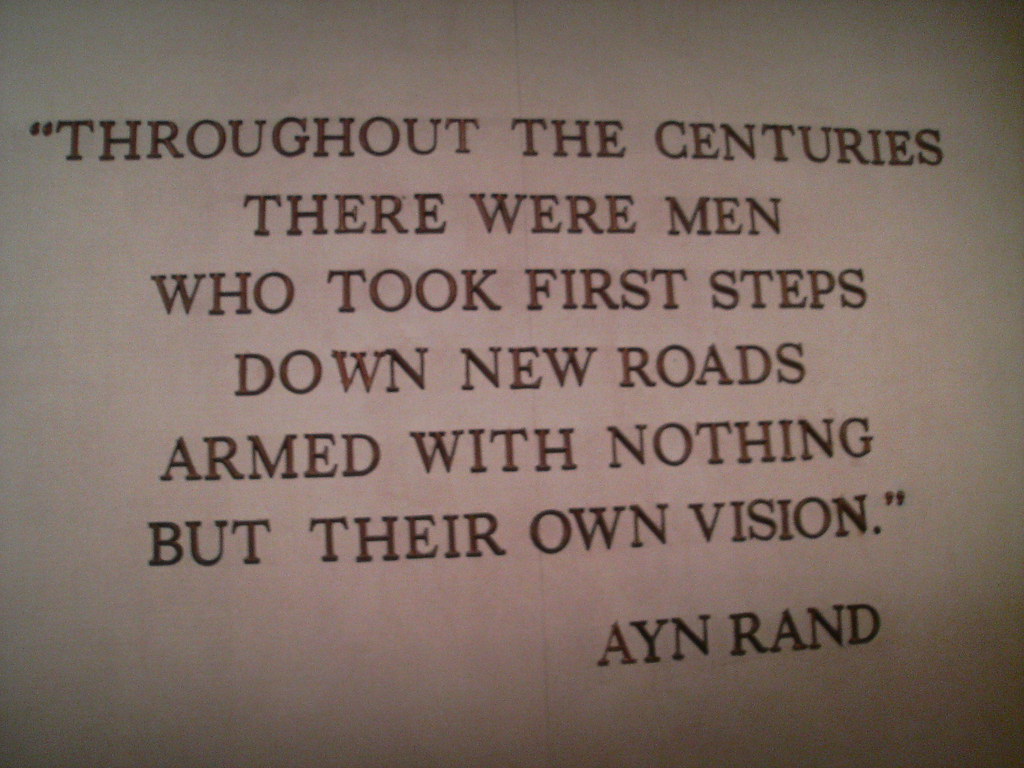
Cross posted @ God is 4 Suckers!aynrandstatement

Achievement of your happiness is the only moral purpose of your life, and that happiness, not pain or mindless self-indulgence, is the proof of your moral integrity, since it is the proof and the result of your loyalty to the achievement of your values. – Ayn Rand

I watched Ayn Rand – A Sense Of Life the other day. This documentary borders almost on hagiography – it doesn’t show any of her warts (as all of us have, none of us are seamless), but relentlessly catalogues her rise to fame.

Ayn Rand

Born in Russia as Alisa Zinov'yevna Rosenbaum, at the age of 12 the Bolshevik revolution wracked her family’s business, and they migrated to Crimea. Later, she enrolled in the University of Petrograd, studying the great philosophers, Plato (whom she despised), Aristotle and Nietzsche (both of whom she admired). She immigrated to the states, changed her name to Ayn Rand, and married an American actor, thereby becoming a U.S citizen.

One of the items I found interesting (one among many) was that she decide at the age of 12, that she was an atheist. This was a choice she stood by her entire life. She hated her native country of Russia, and absolutely loathed communism, and states in one of the myriad television interviews that Russia was a ‘mystical state’, whether it was religious or communist.

The Wiki entry says this of her socio-political views:

Rand held that the only moral social system is laissez-faire capitalism. Her political views were strongly individualist and hence anti-statist and anti-Communist. She exalted what she saw as the heroic American values of rational egoism and individualism. As a champion of rationality, Rand also had a strong opposition to mysticism and religion, which she believed helped foster a crippling culture acting against individual human happiness and success. Rand detested many prominent liberal and conservative politicians of her time, including prominent anti-Communists, such as Harry S. Truman, Richard Nixon, Ronald Reagan, Hubert Humphrey, and Joseph McCarthy's methods.

I’ve always liked old ‘Give ‘em Hell Harry’, and I don’t know enough about Hubert, but she wasn’t far off on the rest of them.

Jim Powell, a senior fellow at the Cato Institute, considers Rand one of the three founders (along with Rose Wilder Lane and Isabel Paterson) of modern American libertarianism, although she rejected libertarianism and the libertarian movement.

Rand's defense of individual liberty almost summarizes her entire philosophy. Since reason is the competent but sole means of human knowledge, it is therefore humanity's most fundamental means of survival. Also, thus, the effort of thinking and the scrupulous use of reason are the most basic virtue of an ethics governed by the requirements of human life. The threat of coercion, however, neutralizes the practical effect of an individual's reason, and whether the force originates from the state or from a criminal, the coerced person must act as required, or, at least, direct his thought to escape. According to Rand, "man's mind will not function at the point of a gun." To put this conversely: freedom "works" because it liberates human reason. Just as freedom of expression is a prerequisite for a vibrant culture, and the development of science and art, so a free market generates new and ever better products and services, as the range of consumer goods and technological innovations in capitalist societies demonstrates, according to Rand. Thus, she argued for the "separation of state and economics in the same way and for the same reasons" as she argued for "the separation of state and church.”

Since reason is "man's basic tool of survival," Rand held that an individual has a natural moral right to act as the judgment of his or her own mind directs and to keep the product of this effort. In Rand's view, this requires that the initiation of physical force and the acquisition of property by fraud be banned. She agreed with America's Founding Fathers that the sole legitimate function of government is the protection of individual rights, including property rights. The purpose of objective criminal and civil law is to protect the individual from the coercion of others, while the purpose of a constitution and Bill of Rights is to protect the individual from the coercion of the state (historically the greatest violator of individual rights in Rand's estimation). Government may use force, that is its essence, but to do so legitimately it must never act as the aggressor––it may use force only in response to an initiation of force, e.g. theft, murder, foreign aggression. Rand did not believe that a free society, one in which all interaction was thus rendered voluntary, would make anyone rational––rationality cannot be compelled and is an exclusive capacity of the individual––but freedom does allow those who are rational and productive to achieve at their highest capacity.

Reason being a capacity of the individual, creative innovation, by its nature, requires the individual to have the freedom to do things differently, to disagree, to buck the trend or consensus, if necessary. According to Rand, therefore, the only type of organized human behavior consistent with the operation of reason is one of voluntary cooperation. Persuasion is the method of reason, a faculty which demands reality be the ultimate arbiter of disputes among men. By its nature, the overtly irrational cannot rely on the use of persuasion, cannot permit the facts to decide differences, and must ultimately resort to force in order to prevail as means of coordinating human behavior. Thus, Rand saw reason and freedom as correlates––just as she saw mysticism and force as correlates.

I can’t add much to that: but she did have some flaws in her reasoning:

Online U.S. News and World Report columnist Sara Dabney Tisdale says academic philosophers have generally dismissed Atlas Shrugged as "sophomoric, preachy, and unoriginal." In addition, Greg Nyquist has written that Rand's philosophy fundamentally misunderstands the very core of human nature. On his blog, Kant scholar William Vallicella has been scathing in describing what he calls her lack of rigour and limited understanding of philosophical subject-matter.

One significant exception to the general lack of attention paid to Rand in academic philosophy is the essay "On the Randian Argument" by Harvard University philosopher Robert Nozick, which appears in his collection, Socratic Puzzles. Nozick is sympathetic to Rand's political conclusions, but does not think her arguments justify them. In particular, his essay criticizes her foundational argument in ethics—laid out most explicitly in her book The Virtue of Selfishness—which claims that one's own life is, for each individual, the ultimate value because it makes all other values possible. Nozick says that to make this argument sound one needs to explain why someone could not rationally prefer dying and thus having no values. Therefore, he argues, her attempt to defend the morality of selfishness is essentially an instance of begging the question. Nozick also argues that Rand's solution to David Hume's famous is-ought problem is unsatisfactory. Tara Smith responds to this criticism in her book Viable Values. Philosophers Douglas Rasmussen and Douglas Den Uyl have also responded to Nozick's article, arguing that there are basic misstatements of Rand's case on Nozick's part.

Rand has also been accused of misinterpreting the works of many of the philosophers that she criticized in her writing. According to Fred Seddon, author of Ayn Rand, Objectivists, and the History of Philosophy (2003), Nathaniel Branden alleged that Rand never read The Critique of Pure Reason by Immanuel Kant. Seddon argued that Kant was not the "mystic" that Rand portrays him as, and presents David Kelley's The Evidence of the Senses: A Realist Theory of Perception complimentarily but critically as "...the book on epistemology that Rand promised but never wrote." Kelley responded to Seddon criticizing him in turn for having missed not only the essential point of his book but also that of the Objectivist epistemology, while Edward Younkins and others have defended Rand's interpretation of Kant's ideas.

Some of the more scathing critiques:

Left-wing linguist and analytic philosopher Noam Chomsky declared Rand to be "[o]ne of the most evil figures of modern intellectual history." Conservative commentator and founder of the National Review William F. Buckley declared: "Ayn Rand is dead. So, incidentally, is the philosophy she sought to launch dead; it was in fact stillborn."

In a 1984 article called "The Benefits and Hazards of the Philosophy of Ayn Rand", Nathaniel Branden, while noting that he was still in general agreement with her ideas, criticized Rand for her "scientific conservatism" and alleged indifference to "anything more recent than the work of Sir Isaac Newton," reporting his "astonishment" at hearing her describe the theory of evolution as "only a hypothesis." In contrast, another associate of Rand, Harry Binswanger has argued in The Biological Basis of Teleological Concepts that natural selection exemplifies Rand's understanding of biological activity. Branden has also stated his belief that Rand was "closed minded" to subjects such as ESP. Her insistence that Objectivism was an "integrated whole," the departure from which necessarily lead one into logical error, led Branden to conclude that her philosophy was "for all practical purposes" a "dogmatic religion". Since the publication of Rand's private journal entries regarding Branden, however, it has been shown that Rand had warned Branden himself against treating her as a "goddess."

I don’t know what to make of Branden: some of it devolves to ‘he said/she said’, but it sounds like her personal life was excessively messy at some points. (But hey, who doesn’t go through that stage?) I’d have to have an actual citation or sound bite, because I’d be willing to be there was more to it than that quick toss-off (and no, a hypothesis is NOT synonymous with theory), and it sounds like her concerns were more with ‘pure’ philosophy than with scientific acumen. And, as ESP hasn’t withstood the rigors of empirical research, that’s a big thumbs down, baby.

I recall having read Atlas Shrugged back in High School, but only vaguely: it didn’t make much of an impact (I was more enamored of Poe and Lovecraft), so I suppose I’ll have to add it to the reading list. It has become popular again, but the film adaptation is a long time in coming. Hopefully no one will muddle it up with gratuitous sex and violence, but I shan’t hold my breath.

The documentary I’ve mentioned is well worth seeing. There are numerous talk-show excerpts (even when she was on Donohue, from the time before he was a ratings whore), and she speaks in a clear, rational fashion that is fascinating to behold.

For those of you who are further interested, here is the website for the Ayn Rand Institute. For a shorter encapsulation:

  1. Reality exists as an objective absolute—facts are facts, independent of man’s feelings, wishes, hopes or fears.
  2. Reason (the faculty which identifies and integrates the material provided by man’s senses) is man’s only means of perceiving reality, his only source of knowledge, his only guide to action, and his basic means of survival.
  3. Man—every man—is an end in himself, not the means to the ends of others. He must exist for his own sake, neither sacrificing himself to others nor sacrificing others to himself. The pursuit of his own rational self-interest and of his own happiness is the highest moral purpose of his life.
  4. The ideal political-economic system is laissez-faire capitalism. It is a system where men deal with one another, not as victims and executioners, nor as masters and slaves, but as traders, by free, voluntary exchange to mutual benefit. It is a system where no man may obtain any values from others by resorting to physical force, and no man may initiate the use of physical force against others. The government acts only as a policeman that protects man’s rights; it uses physical force only in retaliation and only against those who initiate its use, such as criminals or foreign invaders. In a system of full capitalism, there should be (but, historically, has not yet been) a complete separation of state and economics, in the same way and for the same reasons as the separation of state and church.

Any questions? Discuss.

Till the next post, then.

Read More...

Friday, April 03, 2009

The Things That Grind My Gears These Days, I Could Write An Entire Encyclopedia...

But who'd listen, anyways?

So I was just getting out of therapy (physical, so stop right there), and I saw the bumper sticker on your right on an (guess what? Drum roll, please…)
SUV. Sans the SEE ALSO bottom line.

Good thing that person wasn’t in the car. Had they been getting out, they’d have heard me say “Fuck you!” in a very loud voice.

I get a little tired of the same old stupid platitudes. Hey, have you heard this one? Chances are, if you’ve been blogging for around 3-6 months, and said anything defamatory or insulting about religion, or anything resembling a conservative opinion that was horseshit, the response (5 out of 10 times) will be ‘Wow, that’s pretty intolerant for a liberal ’. (You can almost imagine them spitting the word out like insult.)

Why should I be tolerant of stupidity? If someone tells me that they should be able to survive a 40 story drop off a building if they simply believe it strongly enough, I’m going to call bullshit. Likewise, if someone tells me that dropping an atomic bomb should take care of the problems in the Middle East, what am I to do? Nod vacuously, and respect an asshole’s opinion? Not on your life.

So let’s look up a few words, and see what the semantics say.

Liberalism is defined as:

Liberalism emphasizes individual rights and equality of opportunity. Within liberalism, there are various streams of thought which compete over the use of the term "liberal" and may propose very different policies, but they are generally united by their support for constitutional liberalism, which encompasses support for: freedom of thought and speech, limitations on the power of governments, the rule of law, an individual's right to private property, and a transparent system of government. All liberals, as well as some adherents of other political ideologies, support some variant of the form of government known as liberal democracy, with open and fair elections, where all citizens have equal rights by law.

There I am, an American Liberal (I lean more towards the Social Liberal than most of the other definitions, but I’m just keeping it brief here).

Now let’s define Tolerance:

Toleration and tolerance are terms used in social, cultural and religious contexts to describe attitudes which are "tolerant" (or moderately respectful) of practices or group memberships that may be disapproved of by those in the majority. In practice, "tolerance" indicates support for practices that prohibit ethnic and religious discrimination. Conversely, 'intolerance' may be used to refer to the discriminatory practices sought to be prohibited. Though developed to refer to the religious toleration of minority religious sects following the Protestant Reformation, these terms are increasingly used to refer to a wider range of tolerated practices and groups, or of political parties or ideas widely considered objectionable.

The concept of toleration is controversial. For one, "toleration" does not raise the level of an actual principle or ethic, such as other concepts (respect, reciprocity, love) do. Liberal critics may see in it an inappropriate implication that the "tolerated" custom or behavior is an aberration or that authorities have a right to punish difference; such critics may instead emphasize notions such as civility, pluralism, or respect. Other critics may regard a narrow definition of 'tolerance' as more useful, since it does not require a false expression of enthusiasm for groups or practices which are genuinely disapproved of.

(Yeah, I’ve been on about that before, too.)

I’m going in favor of the narrower definition. Your culture celebrates infant sacrifice, random pillaging, rape? YOUR CULTURE IS WRONG, ASSHOLE! There, that simple.

Any questions?

Read More...

Thursday, April 02, 2009

Sometimes, I Get Stupid Liberal Environmentalist Email

I may be a liberal tree-hugger, but that doesn’t mean I have sap for brains. There is such a thing as too much. I got this recently:

You've seen the headlines: Coyotes are attacking humans with more and more frequency. One wandered into a Chicago sandwich shop. Another lives in Central Park in New York. Five people have reported coyote attacks in the Denver area since December. And Colorado officials have responded by killing eight coyotes!

Guess what?!?!? Big fucking deal. Coyotes aren’t anywhere near being on any endangered list. Those eight coyotes! are very easily replaced by about 200 more.

But the real problem isn't coyotes attacking humans, it's human suburban sprawl that increasingly takes over the habitat of wild animals like coyotes. Take action >>

Sorry, sis, but if you were talking spotted owls or condors, creatures that are actually endangered  by man, hey, I’d have fist up to the sky. Coyotes? That fist has a finger extended, guess which one?

Rather than hunting down and killing animals whose habitat has been destroyed by human subdivisions, we should enact stronger urban planning laws that protect the habitat of our nation's wildlife.

Wow, no. Let’s take a look at the species, coyote:


Britannica Concise Encyclopedia: coyote

Species (Canis latrans) of canine found in North and Central America. Its range extends from Alaska and Canada south through the continental U.S. and Mexico to Central America. It weighs about 20 – 50 lbs (9 – 23 kg) and is about 3 – 4 ft (1 – 1.3 m) long, including its 12 – 16-in. (30 – 40-cm) tail. Its coarse fur is generally buff above and whitish below; its legs are reddish, and its tail is bushy and black-tipped. The coyote feeds mainly on small mammals such as rodents, rabbits, and hares but can also take down deer, sometimes doing so in packs. Vegetation and carrion are commonly eaten as well. Though persecuted by humans because of its potential (generally overstated) to prey on domestic or game animals, it has adapted well to human-dominated environments, including urban areas. A coyote-dog cross is called a coydog.

Oh, hey, another proof of evolution! Next up:

US History Encyclopedia: Coyote

Coyote (Canis latrans) is a wild dog species, smaller than Wolves but larger than foxes. The subject of many Native American creation tales and myths, coyotes came under attack during the twentieth century. Livestock ranchers, aided by government bounty hunters, used poison, traps, and aerial hunting to kill 428,849 coyotes in 1988 and an estimated 20 million during the entire century. Nevertheless, coyotes have expanded their numbers and domain from the trans-Mississippi west to every state except Hawaii because they are omnivorous, adaptable, and freed from competitors and predators by those same hunters. Coyotes demonstrate that humans often cannot control nature as they wish.

And one more for good measure:

Columbia Encyclopedia: coyote

coyote (kī'ōt, kīō'tē) or prairie wolf, small, swift wolf, Canis latrans, native to W North America. It is found in deserts, prairies, open woodlands, and brush country; it is also called brush wolf. The coyote resembles a medium-sized dog, with a narrow, pointed face, long, thick, tawny fur and a black-tipped bushy tail. Adult males have a head and body length of about 35 in. (89 cm), with a 14-in. (36-cm) tail; they stand 21 in. (53 cm) at the shoulder and usually weigh about 30 lb (14 kg). The cry of the coyote, heard in the early evening, is a series of high-pitched yelps. Coyotes live in pairs, and both parents care for the young; they make their dens in roots of trees, rock crevices, or in ground burrows made by other animals. They are largely nocturnal, but are also seen in the day. They hunt alone, in pairs, or when hunting larger prey in small groups. Omnivorous feeders, they prey on a variety of small animals, sometimes cooperating to attack larger mammals; they also eat plant matter, carrion, and garbage. They can maintain a speed of 35 mi (56 km) per hour while chasing prey. Coyotes are responsible for destroying some domestic livestock, but they are valuable scavengers and destroyers of rodents. There has almost always been a bounty on coyotes somewhere in the United States, and many thousands are killed each year. Despite this, coyotes have not been reduced in number, and their range has actually increased in the past century, due in part to the fact that many formerly forested areas now more closely resemble the plains and also that the eradication of top-level predators, such as wolves and mountain lions, has left an open ecological niche. Common in the central and W United States, they range N to Alaska, S to Central America, and E to New England; they have even begun to move into urban centers, such as New York City. They are classified in the phylum Chordata, subphylum Vertebrata, class Mammalia, order Carnivora, family Canidae.

So yeah, my heart’s not bleeding for these canine vermin. One of the few species that have thrived and actually tripled in number since the white man hit this continent.

Read More...