left biblioblography

Sunday, April 27, 2008

Allegories Gone Wild - The Jerusalem Syndrome; Is It Something In The Matzoh Balls?

jerusalemCross posted @ God Is For Suckers!

In the wild wacky world of religion, I come across these obscure oddities that make one squint the eyes, cross them, and then roll them to the ceiling.

Such a one is the Jerusalem Syndrome.

The Wiki entry says this:

The Jerusalem syndrome is the name given to a group of mental phenomena involving the presence of either religiously themed obsessive ideas, delusions or other psychosis-like experiences, that are triggered by, or lead to, a visit to the city of Jerusalem. It is not endemic to one single religion or denomination, but has affected Jews and Christians of many different backgrounds.

(Do note the absence of Muslim, Hindu, or other denominations.)

There are three types listed:

Type I

Jerusalem syndrome imposed on a previous psychotic illness. This refers to individuals already diagnosed as having a psychotic illness before their visit to Jerusalem. They have typically gone to the city because of the influence of delusional religious ideas, often with a goal or mission in mind which they believe needs to be completed on arrival or during their stay. For example, an affected person may believe himself to be an important historical religious figure, or may be influenced by important religious ideas or concepts (such as causing the coming of the Messiah or the second coming of Christ).

Type II

Jerusalem syndrome superimposed on and complicated by idiosyncratic ideas. This does not necessarily take the form of mental illness, and may simply be a culturally anomalous obsession with the significance of Jerusalem, either as an individual, or as part of a small religious group with idiosyncratic spiritual beliefs.

Type III

Jerusalem syndrome as a discrete form, uncompounded by previous mental illness. This describes the best known type, whereby a previously mentally balanced person becomes psychotic after arriving in Jerusalem. The psychosis is characterized by an intense religious character and typically resolves to full recovery after a few weeks, or after being removed from the locality. It shares some features with the diagnostic category of a 'brief psychotic episode', although a distinct pattern of behaviours has been noted:

  1. Anxiety, agitation, nervousness and tension, plus other unspecified reactions.
  2. Declaration of the desire to split away from the group or the family and to tour Jerusalem alone. Tourist guides aware of the Jerusalem syndrome and of the significance of such declarations may at this point refer the tourist to an institution for psychiatric evaluation in an attempt to preempt the subsequent stages of the syndrome. If unattended, these stages are usually unavoidable.
  3. A need to be clean and pure: obsession with taking baths and showers; compulsive fingernail and toenail cutting.
  4. Preparation, often with the aid of hotel bed-linen, of a long, ankle-length, toga-like gown, which is always white.
  5. The need to shout psalms or verses from the Bible, or to loudly sing religious hymns or spirituals. Manifestations of this type serve as a warning to hotel personnel and tourist guides, who should then attempt to have the tourist taken for professional treatment. Failing this, the two last stages will develop.
  6. A procession or march to one of Jerusalem's holy places.
  7. Delivery of a ‘sermon’ in a holy place. The sermon is usually very confused and based on a plea to humankind to adopt a more wholesome, moral, simple way of life.

Bar-El et al. reported 42 such cases over a period of 13 years, but in no case were they able to actually confirm that the condition was temporary.

Of course, the religious among us will point to this as some sort of proof positive of the spiritual world, but in fact, this sort of item occurs in the case of the Stendhal Syndrome or the Paris Syndrome. Usually the latter tend to be spectacularly less...violent.

I have discussed elsewhere the fact that we as a species do indeed tend to have hallucinations - it seems to be in our blood (to beg a metaphor).

There's a citation here, about one Michael Rohan (yes, you guessed a-right - he was Christian), who

was overwhelmed with a feeling of divine mission and was apparently intent on starting Word War III in order to bring about the coming of the Messiah. He set fire to the al-Aqsa Mosque and caused minor damage. This act precipitated citywide rioting and threats of holy war  (Jihad) that were broadcast on virtually every Arab language radio station in the Middle East.

X-Project magazine states:

Although the Jerusalem Syndrome affects many that have a history of psychiatric problems, many who experience the same delusions are sane, healthy and successful businessmen, teachers, and professionals. The Syndrome usually affects Protestant Christians, but it has also been reported in religious Jews and in rare cases, Catholics. Usually lasting about a week, most can be brought back to reality (with help) and have no memory of their short-lived Biblical persona.
The most obvious cause of the Jerusalem Syndrome is religious fanaticism. The fact that it only affects Christians and some Jews suggests that subjects are prone to feeling a desire to be "called of God" and may interpret impressions and feelings that they get from touring the city as an actual Godly summons.
One of the more controversial theories suggests that the Jerusalem Syndrome has been around before Christianity, and may have actually contributed to the founding of the religion. This theory suggest that historical Bible figures such as John the Baptist, the apostles, and even Jesus Christ were affected by the syndrome. This, however, does not provide an explanation as to the origins of such phenomenon.
The Jerusalem Syndrome is not entirely exclusive to Jerusalem. All over the world, many people forsake otherwise ordinary lives to live out a Bible-hero persona.

The Savvy Traveler states that this is a very real problem, and relates an interesting anecdote:

Bar-El talks about a memorable case which actually led to one of the first instances of collaboration between Palestinian and Israeli police. The Palestinians found a man without clothes, money or ID, and, after interrogation, they figured out he wasn't a security risk. They had no idea what to do with him, so they contacted an Israeli officer. The Israeli asked only one question: "Is the guy really completely nude?" "No," answered the Palestinian, "he's wearing an animal skin." "Oh," said the Israeli, "you've got another John the Baptist." It was the sixth John the Baptist the Israelis had run into. They usually did days of purification between Jerusalem and the Galilee before ending up at the Jordan River to baptize Jesus or the first Christians, and part of the trek was through Palestinian territory.

John The Baptist is the most popular Jerusalem syndrome choice for Christian men. Christian women prefer the Virgin Mary. For Jews of both sexes, the identification is generally with the Messiah.

My best guess is that it's something in the water, air, or food, that triggers some form of a chemical imbalance.

Everything.com reports that:

A strange little condition in which tourists to the holy city of Jerusalem start to believe they are biblical characters, or of biblical importance. About 100 people a year get this disorder, with about 40 actually needing hospitalization. Currently, all patients go to Dr. Yair Bar-El at Jerusalem's psychiatric hospital Kfar Shaul.

M. Kalian and E. Witztum report about 1/2 of that number, out of an average of 2 million tourists annually. In fact, the numbers appear to vary.

The thought of all these faux Johnny Baptists running about unfettered is more than a little unsettling. While the numbers seem less than alarming, recall Rohan, who set off riots by burning mosques.

Perhaps more investigation into this phenomenon would provide us with key insights as to the psychological anomalies that pertain to the religious.

And history tells us, that one person in the right place and the right time can set ablaze a countryside with a single spark of madness.

 Till the next post, then.

Read More...

Thursday, April 24, 2008

Objections To Astrology

This was mentioned in Harlan Ellison's Edgeworks that I was re-reading (for the umpteenth time: have I mentioned he's a personal hero of mine?) recently, and it has such bearing even today (the statement was released in 1975! Will people ever wake up and learn?), that I thought I should bring it to the attention of whichever readers I haven't offended yet:

Objections to Astrology

http://www.americanhumanist.org/about/astrology.html

A Statement by 186 Leading Scientists

(The following statement first appeared in The Humanist of September/October 1975.)

Scientists in a variety of fields have become concerned about the increased acceptance of astrology in many parts of the world. We, the undersigned—astronomers, astrophysicists, and scientists in other fields—wish to caution the public against the unquestioning acceptance of the predictions and advice given privately and publicly by astrologers. Those who wish to believe in astrology should realize that there is no scientific foundation for its tenets.

In ancient times people believed in the predictions and advice of astrologers because astrology was part and parcel of their magical world view. They looked upon celestial objects as abodes or omens of the gods and, thus, intimately connected with events here on earth; they had no concept of the vast distances from the earth to the planets and stars. Now that these distances can and have been calculated, we can see how infinitesimally small are the gravitational and other effects produced by the distant planets and the far more distant stars. It is simply a mistake to imagine that the forces exerted by stars and planets at the moment of birth can in any way shape our futures. Neither is it true that the position of distant heavenly bodies make certain days or periods more favorable to particular kinds of action, or that the sign under which one was born determines one's compatibility or incompatibility with other people.

Why do people believe in astrology? In these uncertain times many long for the comfort of having guidance in making decisions. They would like to believe in a destiny predetermined by astral forces beyond their control. However, we must all face the world, and we must realize that our futures lie in ourselves, and not in the stars.

One would imagine, in this day of widespread enlightenment and education, that it would be unnecessary to debunk beliefs based on magic and superstition. Yet, acceptance of astrology pervades modern society. We are especially disturbed by the continued uncritical dissemination of astrological charts, forecasts, and horoscopes by the media and by otherwise reputable newspapers, magazines, and book publishers. This can only contribute to the growth of irrationalism and obscurantism. We believe that the time has come to challenge directly, and forcefully, the pretentious claims of astrological charlatans.

It should be apparent that those individuals who continue to have faith in astrology do so in spite of the fact that there is no verified scientific basis for their beliefs, and indeed that there is strong evidence to the contrary.

Sponsoring Committee

(Affiliations, as of 1975, given for identification only.)

Bart J. Bok, emeritus
Professor of Astronomy
University of Arizona

Lawrence E. Jerome
Science Writer
Santa Clara, California

Paul Kurtz
Professor of Philosophy
SUNY at Buffalo

Signed by 183 others, including 18 Nobel Prizewinners

Twenty-three years later, and it makes so much sense, I can add nothing to it.

Read More...

Wednesday, April 23, 2008

Anti-Semitism - Your Christian Heritage

In these week of Passover (no, I'm not Jewish. No, I'm not celebrating it.), these thoughts have been nagging at me.

Now, Passover is a celebration of the Exodus from Egypt, a seminal event in their annals, one that we the educated know never happened.

Of all the peoples of the world, I doubt there is one group that is more hated, more reviled, more spat upon and more mistreated than the Jews.

I think this is well past its shelf life. It should've expired by now. But to this day, Holocaust deniers and anti-Semites seem to abound on both sides of the polarized political sphere. More on the left side than the right.

Michael Shermer, in his excellent book Why People Believe Weird Things, that Holocaust deniers tend to focus a great deal on the doings of the Jews.

So, for the nutshell version:

They left Israel, and wandered for centuries. They have dwelled in almost every country on earth. And in doing so, have been discriminated against, slaughtered at the whimsy of local populaces, and otherwise been the scape goat of each of those respective societies. From Luther to Hitler, there's been centuries of horror perpetrated against them. When the Final Solution was enacted, it was apparently the last straw. Zionism (a lackluster movement until then) picked up the banner, and the push for a safe haven for the Jews became more of a shove.

Can we blame that old whore Christianity for it? The bastard child of Judaism, the chameleon of many colors, that borrowed heavily from an epistemology not its own? Of course we can.

Matthew 27:

20 But the chief priests and elders persuaded the multitude that they should ask Barabbas, and destroy Jesus.

21 The governor answered and said unto them, Whether of the twain will ye that I release unto you? They said, Barabbas.

22 Pilate saith unto them, What shall I do then with Jesus which is called Christ? They all say unto him, Let him be crucified.

23 And the governor said, Why, what evil hath he done? But they cried out the more, saying, Let him be crucified.

24 When Pilate saw that he could prevail nothing, but that rather a tumult was made, he took water, and washed his hands before the multitude, saying, I am innocent of the blood of this just person: see ye to it.

25 Then answered all the people, and said, His blood be on us, and on our children.

This then, is the root of xenophobic hatred. There's more to be found here, all of it revolting. There's even a table of comparison showing  canonical law juxtaposed to the Nazi anti-Jew laws. The correlation is chilling.

That the concept of the scapegoat originated with the Jews is an irony not lost upon me.

I am not intimating in the slightest that Israel is above approach. That country should be criticized like any other, a level playing field. Nor am I elevating the Jews to another plateau on the concept of reparation. I have (on more than one occasion) mocked their superstitions acerbically.

Presently, most on the left are carrying on about Israel accepting faith-based money ("Hey, y'all live in the Promised Land. The Ah-pock-oh-lips is a-comin'!"). So let me trot out a little analogy for ya:

If a Christian (or even a Scientologist! HORRORS!) were to rescue me from, say, a gang out for a wilding, or throw me a lifejacket while I was drowning, or offer me a hand up as I hung off a cliff, well, I'd be some kind of jackass to refuse on principle. (Of course, were the Xenuphiliac to know that I'm an SP, chances are good that s/he'd be more likely to pry my fingers off the rock.)

I am pointing out that when someone begins to lather at the mouth about the Zionist movement, the ridiculous blatherings about 'apartheid' or 'ethnic cleansing' (there's been one incident, the Palistinean Exodus, which Israel was clearly guilty of, in 1948), or genocide (compare the population figures from 1948 to that of today, and get back to me on that), that person should stop and think.

I might even suggest that this is a meme passed on for many generations. I might hint that this is an old, old legacy carried on for generations by Christians. I might propose that you should carefully examine the epistemology of the opinion you opine upon (say that three times fast, I dare ya): you may very well be carrying on an old religious tradition unwittingly.

A tradition better served by a funeral pyre, upon which we scrap the useless memes and traditions of superstitions and xenophobia.

So think, and clearly.

L'chaim.

Read More...

Sunday, April 20, 2008

Allegories Gone Wild - "Forbidden Archeology": A (Non) Book Review

Cross-posted at God Is For Suckers!red_crag_shell

If you're anything like myself, you probably like to check out books prior to purchase. Money's money, right?

So I stumbled upon this little gem, and it piqued my interest. Humanity being much older than the accepted 100,000 years? Hmmm...

So, I foraged. Data mined, what have you.

In 1979, researchers at the Laetoli, Tanzania, site in East Africa discovered footprints in volcanic ash deposits over 3.6 million years old. Mary Leakey and others said the prints were indistinguishable from those of modern humans. To these scientists, this meant only that the human ancestors of 3.6 million years ago had remarkably modern feet. But according to other scientists, such as physical anthropologist R. H. Tuttle of the University of Chicago, fossil bones of the known australopithecines of 3.6 million years ago show they had feet that were distinctly apelike. Hence they were incompatible with the Laetoli prints. In an article in the March 1990 issue of Natural History, Tuttle confessed that "we are left with somewhat of a mystery." It seems permissible, therefore, to consider a possibility neither Tuttle nor Leakey mentioned--that creatures with anatomically modern human bodies to match their anatomically modern human feet existed some 3.6 million years ago in East Africa. Perhaps, as suggested in the illustration on the opposite page, they coexisted with more apelike creatures. As intriguing as this archeological possibility may be, current ideas about human evolution forbid it.

Gotta love that last bit, no? From much of my reading at Pharyngula, I gather that it's not uncommon in evolution for anomalies in the fossil record to show some startlingly modernistic characteristics in ancient lineage. These tend to come and go, however. Besides which, this has been adequately explained here. The footprints are much smaller than modern humans, and besides which, are obviously contaminated by the environment.

Knowledgeable persons will warn against positing the existence of anatomically modern humans millions of years ago on the slim basis of the Laetoli footprints. But there is further evidence. Over the past few decades, scientists in Africa have uncovered fossil bones that look remarkably human. In 1965, Bryan Patterson and W. W. Howells found a surprisingly modern humerus (upper arm bone) at Kanapoi, Kenya. Scientists judged the humerus to be over 4 million years old. Henry M. McHenry and Robert S. Corruccini of the University of California said the Kanapoi humerus was "barely distinguishable from modern Homo." Similarly, Richard Leakey said the ER 1481 femur (thighbone) from Lake Turkana, Kenya, found in 1972, was indistinguishable from that of modern humans. Scientists normally assign the ER 1481 femur, which is about 2 million years old, to prehuman Homo habilis. But since the ER 1481 femur was found by itself, one cannot rule out the possibility that the rest of the skeleton was also anatomically modern. Interestingly enough, in 1913 the German scientist Hans Reck found at Olduvai Gorge, Tanzania, a complete anatomically modern human skeleton in strata over 1 million years old, inspiring decades of controversy.

The Kanapoi humerus? See here. Oldoway Man? See here.

Here again, some will caution us not to set a few isolated and controversial examples against the overwhelming amount of noncontroversial evidence showing that anatomically modern humans evolved from more apelike creatures fairly recently--about 100,000 years ago, in Africa, and, in the view of some, in other parts of the world as well.

The current evidence points to yes, but this fellow is sideways hinting that he's found evidence that says otherwise.

But it turns out we have not exhausted our resources with the Laetoli footprints, the Kanapoi humerus, and the ER 1481 femur. Over he past eight years, Richard Thompson and I, with the assistance of our researcher Stephen Bernath, have amassed an extensive body of evidence that calls into question current theories of human evolution. Some of this evidence, like the Laetoli footprints, is fairly recent. But much of it was reported by scientists in the nineteenth and early twentieth centuries. And as you can see, our discussion of this evidence fills up quite a large book.

As we are in the 21st CE, any assumptions/theories/hypotheses made by scientists in the earlier years deserves more the critical eye: the techniques used back then were cruder, the base of knowledge much smaller than now. And interpretations vary, usually changing as the knowledge base grows and the science refines.

I'm going to skip ahead here and there: it's a lengthy intro to the book, and the reader is welcome to read the whole synopsis.

In the first chapter of Part I of Forbidden Archeology, we survey the history and current state of scientific ideas about human evolution. We also discuss some of the epistemological principles we employ in our study of this field. Principally, we are concerned with a double standard in the treatment of evidence.

We identify two main bodies of evidence. The first is a body of controversial evidence (A), which shows the existence of anatomically modern humans in the uncomfortably distant past. The second is a body of evidence (B), which can be interpreted as supporting the currently dominant views that anatomically modern humans evolved fairly recently, about 100,000 years ago in Africa, and perhaps elsewhere.

We also identify standards employed in the evaluation of paleoanthropological evidence. After detailed study, we found that if these standards are applied equally to A and B, then we must accept both A and B or reject both A and B. If we accept both A and B, then we have evidence placing anatomically modern humans millions of years ago, coexisting with more apelike hominids. If we reject both A and B, then we deprive ourselves of the evidential foundation for making any pronouncements whatsoever about human origins and antiquity.

Historically, a significant number of professional scientists once accepted the evidence in category A. But a more influential group of scientists, who applied standards of evidence more strictly to A than to B, later caused A to be rejected and B to be preserved. This differential application of standards for the acceptance and rejection of evidence constitutes a knowledge filter that obscures the real picture of human origins and antiquity.

So, the short version: "Listen to us, we have the actual evidence that humanity existed millions of years ago. We even have real scientists, influential ones, who agree with us!" Do they? Let's see.

Chapter 2 deals with anomalously old bones and shells showing cut marks and signs of intentional breakage. To this day, scientists regard such bones and shells as an important category of evidence, and many archeological sites have been established on this kind of evidence alone.

In the decades after Darwin introduced his theory, numerous scientists discovered incised and broken animal bones and shells suggesting that tool-using humans or human precursors existed in the Pliocene (2-5 million years ago), the Miocene (5-25 million years ago), and even earlier. In analyzing cut and broken bones and shells, the discoverers carefully considered and ruled out alternative explanations--such as the action of animals or geological pressure--before concluding that humans were responsible. In some cases, stone tools were found along with the cut and broken bones or shells.

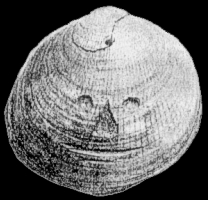
A particularly striking example in this category is a shell displaying a crude yet recognizably human face carved on its outer surface.

Reported by geologist H. Stopes to the British Association for the Advancement of Science in 1881, this shell, from the Pliocene Red Crag formation in England, is over 2 million years old. According to standard views, humans capable of this level of artistry did not arrive in Europe until about 30,000 or 40,000 years ago. Furthermore, they supposedly did not arise in their African homeland until about 100,000 years ago.

(Note to the intrepid, curious reader: this particular piece of 'artwork' is what you see on the upper right hand corner of this post. It could've fallen a few feet and gotten those markings just as easily)

Concerning evidence of the kind reported by Stopes, Armand de Quatrefages wrote in his book Hommes Fossiles et Hommes Sauvages (1884): "The objections made to the existence of man in the Pliocene and Miocene seem to habitually be more related to theoretical considerations than direct observation."

1884? Are you kidding me?

The most rudimentary stone tools, the eoliths ("dawn stones") are the subject of Chapter 3. These imlements, found in unexpectedly old geological contexts, inspired protracted debate in the late nineteenth and early twentieth centuries.

For some, eoliths were not always easily recognizable as tools. Eoliths were not shaped into symmetrical implemental forms. Instead, an edge of a natural stone flake was chipped to make it suitable for a particular task, such as scraping, cutting, or chopping. Often, the working edge bore signs of use.

As to eoliths, answers.com gave me this:

Obsolete term, formerly used for a naturally shaped or fractured stone fancifully considered to be created by humans. The origin of eoliths was once the subject of long-running debate connected to recognizing and accepting the great antiquity of the human species.

In Chapter 6, we review discoveries of anomalously old skeletal remains of the anatomically modern human type. Perhaps the most interesting case is that of Castenedolo, Italy, where in the 1880s, G. Ragazzoni, a geologist, found fossil bones of several Homo sapiens sapiens individuals in layers of Pliocene sediment 3 to 4 million years old. Critics typically respond that the bones must have been placed into these Pliocene layers fairly recently by human burial. But Ragazzoni was alert to this possibility and carefully inspected the overlying layers. He found them undisturbed, with absolutely no sign of burial.

This adequately explains Castendolo Man. Colin Groves (at the Talkorigins site) does a brief review of the book here.

Are you starting to glaze over? I was. So I skipped ahead.

Just as Groves points out, these fellows (Michael A. Cremo and Richard L. Thompson) are affiliated with the Bhaktivedanta Institute - Cremo is a Vedic creationist, no less. So he (and his erstwhile buddy) rail about presupposition, all the while approaching the 'evidence' in an effort to prove their...eccentric viewpoint.

A quote from the link above:

Professor Jonathan Marks, a biological anthropologist at the University of North Carolina who reviewed Cremo's book in the American Journal of Physical Anthropology, said Cremo relies on poorly documented 19th century archaeological finds.

"What Cremo does in `Forbidden Archaeology' is he takes all this stuff that has been confined to the rubbish pile and says, `Look at all this evidence that archaeologists have ignored,"' Marks said. "It's not evidence at all. He believes humans existed in the Precambrian era, but the world was a very different place then. There was no oxygen, there was no life; without multi-cellular organisms, there wouldn't have been anything for them to eat."

Caught between two extremes: the Young Earthers and the Vedic contortionists. Hard to tell, sometimes, which ones are crazier than the others. I mean, they all go rooting in the trashbins of science and holler "Eureka!" when they find something that might vaguely support a premise treading on thin ice.

All the while, fool's gold.

Till the next post, then.

Read More...

Sunday, March 30, 2008

A Religious 'Indulgence' - The Rag That Became A 'Relic'

Cross posted at God is for Suckers!

clownshroudThis bit of religious skullduggery caught my eye recently:

Shroud mystery 'refuses to go away'

There are very few Christian relics as important and as controversial as the Shroud of Turin.

This linen cloth, measuring about 4.4m by 1.1m (14.4x3.6 feet) holds the concealed image of a man bearing all the signs of crucifixion.

Which begs the question: has anyone ever run tests on any other 'shroud' besides this one?

Scientific tests have proved that there are blood stains around the marks consistent with a crown of thorns and a puncture from a lance to the side.

Ummm...no. This isn't the whole story.

There are several reddish stains on the shroud suggesting blood. McCrone (see above) identified these as containing iron oxide, theorizing that its presence was likely due to simple pigment materials used in medieval times. Other researchers, including Alan Adler, a chemist specializing in analysis of porphyrins, identified the reddish stains as type AB blood and interpreted the iron oxide as a natural residue of that element always found in mammalian red blood cells.

[...]

The particular shade of red of the supposed blood stains are problematic, according to skeptics of the shroud's authenticity. Normally, whole blood stains discolor relatively rapidly, turning to a black-brown shade, while these stains range from a red to a brown color. Skeptics claim that: " Blood has not been identified on the shroud directly, but it has been identified on sticky tape that was used to lift fibrils from the shroud. Dried, aged blood is black. The stains on the shroud are red. Forensic tests on the red stuff have identified it as red ocher and vermilion tempera paint." and that if there is blood: "it could be the blood of some 14th century person. It could be the blood of someone wrapped in the shroud, or the blood of the creator of the shroud, or of anyone who has ever handled the shroud, or of anyone who handled the sticky tape. But even if there were blood on the shroud, that would have no bearing on the age of the shroud or on its authenticity.

Until the 1980s, millions of Christians around the world believed the Shroud to be the burial cloth of Christ.

Put simply, it meant that for millions of people the Shroud was, in effect, a Polaroid of Jesus' death - a snapshot of the defining moment in Christianity. It put the Shroud in a league of its own in the realm of the most important Christian relics.

But in 1989, the significance of the Shroud seemed to evaporate after a radiocarbon dating test pronounced a stunning verdict - the Shroud of Turin was indisputably a medieval fake.

Again, not the whole story (from previous link):

In 1988, the Holy See agreed to permit six centers to independently perform radiocarbon dating on portions of a swatch taken from a corner of the shroud, but at the last minute they changed their minds and permitted only three research centers to independently perform radiocarbon dating. All three, Oxford University, the University of Arizona, and the Swiss Federal Institute of Technology, agreed with a dating in the 13th to 14th centuries (1260–1390).The scientific community had asked the Holy See to authorize more samples, including from the image-bearing part of the shroud, but this request was refused. One possible account for the reluctance is that if the image is genuine, the destruction of parts of it for purposes of dating could be considered sacrilege. Another possibility is that the Church is reluctant to risk exposing the Shroud as a forgery.

My bets on the latter. Any takers?

Mr Jackson, a lecturer in physics and cosmology (author's note: I introduced this link, since obviously Mr. Jackson doesn't practice this form of it.)

, introduced me to a wealth of fresh historical and forensic evidence that linked the Shroud of Turin to two earlier Shrouds of Christ.

The first was in Constantinople and mysteriously disappeared in the sack of the city in the Fourth Crusade in 1204. The second is, of course, the Shroud referred to in the Gospels.

Who is this mysterious Mr. Jackson? None other than John P. Jackson, director and founder of TSC - The Turn Shroud Center of Colorado. Methinks me catches a whiff of presuppositionalism here.

The irresistible force of science seems to have hit an immovable object. The mysterious image of a crucified man has refused to lie down and die.

The 'immovable object' seems to be the traditional wall of ignorance erected by the religious. What a shock.

The new evidence raises a question mark over that carbon-14 verdict. Should the margin of error have been wider? Could the image on the Shroud have been forged earlier in time?

Anyone who does more than a 5 minute investigation into the maelstrom of yea-sayers and nay-sayers, will likely be blinking their eyes at it as I did. The damn thing's been more handled than Warren Beatty's unmentionables. Contamination, anyone? Nuns patched it up after a fire. From the answers.com link:

There are numerous reports of Jesus' burial shroud, or an image of his head, of unknown origin, being venerated in various locations before the fourteenth century.[2] However, none of these reports has been connected with certainty to the current cloth held in the Turin cathedral. Except for the Image of Edessa, none of the reports of these (up to 43) different "true shrouds" was known to mention an image of a body.

And yes! There was a denunciation:

In 1389, the image was denounced as a fraud by Bishop Pierre D'Arcis in a letter to the Avignon Antipope Clement VII, mentioning that the image had previously been denounced by his predecessor Henri de Poitiers, who had been concerned that no such image was mentioned in scripture. Bishop D'Arcis continued, "Eventually, after diligent inquiry and examination, he discovered how the said cloth had been cunningly painted, the truth being attested by the artist who had painted it, to wit, that it was a work of human skill and not miraculously wrought or bestowed." (In German: [4].) The artist is not named in the letter.

I'm including here a more exacting analysis that really rips the shroud a new one.

It's a worn piece of cloth (cunningly wrought, I'll grant you that), a vestige of dirty laundry from the Middle Ages that should be de-classified as a mystery and instead, slotted as a fraud like so many other religious forgeries. More of an example of how the religious 'see it the way they call it'.

For a more humorous explanation, watch this short video.

I'd advise Jackson to get a hobby.

Till the next post, then.

Read More...

Friday, March 28, 2008

A Magnificent Example Of Natural Selection

The Lyre bird can imitate anything it hears:

Truly astounding.

Read More...

Wednesday, March 26, 2008

Draped In This Cloak Of Flesh, The Needs That Burn Us...

Close on the heels of the Spitzer scandal, I read this Chronicle column the other day in the newspaper (yes! An actual, bonafide newspaper! In the 21st century, no less!), and I gotta say: I don't agree at all.

Let's fisk this, and then we can get to the 'meat' of the matter.

There was one, and probably only one, reaction to the Eliot Spitzer scandal that surprised me: the idea, which appears to be widespread among a startling number of people, that the former governor's travails just "prove" that it's "time" to legalize prostitution (or sex work, to use the more polite term).

Like perhaps, in ancient Greece? That old adage about the 'oldest profession' isn't just a cliche, it's a fact.

The first time I heard someone railing on in this vein, I sat there, mouth agape, while he went down a long and rather incoherent list of excuses. I chalked it up to one guy's delusions, but then I heard it again and again from otherwise intelligent people (male and female) who had, I believed, a sensible grasp of reality, that is, a sense of the gap between the way that we think things should be and the way they turn out to be in daily life.

I'd have liked to have heard some of these 'incoherent excuses', but I'll assume Ms. Caille had to use some judgment inasmuch as she had a word limit.

Regardless, that's almost (but not quite) the logical fallacy of poisoning the well. I catch a hint of that American cultural cliche of 'well, he's just a man, and they all think with two parts of their bodies', but I could be wrong.

I'll start with some of the arguments I've heard recently in favor of legalizing sex work:

-- The 'people do it anyway' defense. Well, sure. But then, people also murder other people "anyway," and no one's clamoring to legalize that.

Variant on the old slippery slope routine - basically, same old razz-matazz. We let this one slide, and before you know it, there'll be rapine and murder in the streets.

Trying to make a case for whatever situation you want legalized based on the idea that some people will flout the law is the thinnest of all defenses. It groups all of us with that aberrant strain of humanity that will flout any law, and when we are making laws we need to appeal to what's reasonable, and what's good, in all of us.

Yeah, oh, say, like Prohibition? That worked out well, didn't it?

It also neglects the fact that our legal system isn't written simply for the purpose of expediency, it's also written to underline morality. You can argue about whether or not it's moral to legalize the practice of selling sex - I don't believe that it is - but not on the concept that "it happens."

Ummm...'morality' isn't a concrete constant. There was a time when homosexuality was a mental disorder, it was a-okay to ship your kid off to the factory for 12 hour days, and yes, even the good ole bible told you that it was perfectly satisfactory to sell your daughter into slavery.

And yes, you do indeed legalize things on the basis of "it happens". If it happens regularly enough, it becomes common-place. And then accepted. Because the majority doesn't decide what's moral, it decides on what's acceptable.

Really. Do us all a favor, get a clue.

Which brings me to another common argument:

-- The 'since people are already doing it, why not make it safe' defense. Note: This defense is usually backed up with a story that begins, 'When I went to Amsterdam...'

Sigh. Well, the people who believe that American public health departments can magically eliminate the violence and exploitation that tend to accompany sex work are more optimistic than I am.

'Magically'? What a stupid comment. You have an activity that's been pushed underground for a few centuries, this'll take years (maybe decades) of reform. Are we on the same planet?

Evidence about this stuff is always highly contested, but there is some that those issues have been exacerbated in and around the parts of Nevada where some legal prostitution is allowed. And those "issues," in case you weren't familiar with them, include rape, physical assaults, robbery and human trafficking.

I'd love to see these statistics. She rattles them off convincingly enough, but I found this under the Wiki entry:

State law requires that registered brothel prostitutes be checked weekly for several sexually transmitted diseases and monthly for HIV; furthermore, condoms are mandatory for all oral sex and sexual intercourse. Brothel owners may be held liable if customers become infected with HIV after a prostitute has tested positive for the virus.

Which is a far cry from most other states. Were I to avail myself of such services, I'd much rather have references and a clean bill of health, please, instead of sneaking about in some dingy part of town.

(The latter, by the way, is already a major, underpoliced, and undervalued problem in the city of San Francisco. There are a lot of city officials here who don't think it's a serious crime; I hope no one fools them into getting on a boat to a foreign country and then locks them up in a confined space for months or years.)

I have no doubt that women are getting shang-haied, both here and in other countries. It's a heinous practice, but how is it related to the topic at hand? It's not: it's a petty rhetorical practice with a slice of non sequitur thrown in.

Those are pretty serious consequences, in my opinion, and I don't know how you can argue in good conscience that the risk of making them worse is worth the opportunity to ensure that some sex workers submit to a regular battery of sexually transmitted disease tests.

More slippery slope statements. So, having needle-riddled prostitutes risking the public safety (because let's face it: there will always be a supply and demand for this sort of thing - history's proven that a thousand times over), and organized crime and sexual predators preying on them to generate income is a good thing? Oh please.

-- Prostitution can be a 'positive' thing for women. This argument is the least likely to be said with a straight face, because most people don't really believe that having sex you don't enjoy with strangers who you don't like is a positive thing, but the people who believe this argument really believe it, so to them I'll just say: It's not.

I'll have to go along with this to a point. If we reduced poverty, educated children properly (not based on pay scale), and actually got past this weird Victorian love-hate relationship with sex this culture seems to thrive on (don't blink at me: think about it), and stopped treating this profession as if the person who engaged in it was less than human, we'd be better off.

I've read that in Thailand, women actually aspire to be bar girls. That's not a good thing - but in a Third World country, it's not as if there's a plethora of options. Bar girls in China actually send money back to their family.

It's really, truly not. No woman wants to be reduced to her body parts. There are reasons why so many sex workers were abused as children, suffer from substance abuse problems, and have feelings of low self-worth, and it's not because they've got such healthy jobs. It's because they already feel like they've been devalued, and now they are in a profession that reinforces that.

Yeah, let's just bypass the fact that many women are living below the standards that enable them to get these 'healthy jobs'. Maybe you should be fighting against poverty and the stark educational standards of the sub-par schools, more people would have a better chance.

Finally, there really is a moral argument to be made against legalizing prostitution, and it's a simple one: Is this the kind of "career route" you would want for your sister or your daughter? People who like to pontificate about how we "need" to legalize prostitution always fall silent when I ask them that question, because if you believe that it should be legalized then odds are it's because you believe that someone else will bear the brunt of the pain that comes with it. Not the nice people you know.

I can't say that I'm overly thrilled about the concept. But if it were rendered legal, and a worthy profession? It was once, you know. That is, until the religious people took over, horrified that humanity should actually engage their natural urges. In the current clime? Hell no. In Nevada? That'd be a horse of a different color.

Now, there are definitely things about our prostitution laws that I think we should change - namely, the fact that they tend to focus on the act of selling sex, rather than the act of soliciting it. Focusing on the johns and the pimps seems far more fair to me, and it would probably have the unintended benefit of reducing violence against sex workers. The kind of person who's eager to assert brutality against someone who's vulnerable is exactly the kind of person who will stop what he's doing if he doesn't think he'll be able to get away with it.

Here's how you 'focus' on the pimps and johns: legalize it. Let's face facts: there are wack jobs and freak shows galore, not just here but everywhere. If there had been no prostitution in England, I'm willing to bet old Jack the Ripper would've sliced up someone based on the slimmest of excuses. Henry Lee Lucas, sick bastard that he was, didn't need the excuse - it just had to be a woman.

Make it legal, regulate it: that will go a lot farther in reducing the criminal aspect of it. Fact is, keeping it illegal will just keep the vermin's fingers in the pot. It's a victimless crime, when indeed, it should be no crime at all.

And, the fact of the matter is, there are men out there who can't get laid at all. There's a variety of them. It's not about some 'sad sack who can't get it' (let's all rise and blast a raspberry at Oprah): there are men that are horribly disfigured, paraplegic, amputees, who for one reason or another can't seem to 'rise' above a handicap, physical or mental. I might also add, there are plenty of women out there who can't either, for many of the same reasons. Don't tell me this is gender-centric: women indulge this 'vice' as well. Perhaps not in the same numbers as men do, but they're out there. Most won't cop to it, outside of some squalid Fox game show.

Oh, and where was the outrage when a famous evangelist was busted for having sex with a male prostitute, I might ask? Did anyone carry on about how Mike Jones was 'reduced to body parts'? Who sputtered in moral umbrage that a young man was prostituting himself? I don't recall one peep on that subject.

This is basically an entire argument from outrage, based on the most tenuous of concepts: the old is-ought problem.

There 'is' a prostitution problem - there 'ought' to be no such thing at all. It's a flimsy band-aid on a gaping wound that needs stitches.

Let's deal with it as a reality, instead of the old 'out of sight, out of mind' crap. Making it illegal is exactly that. Slapping more laws on the issue will drive it further underground. Which will result in more disease, back-alley abortions, and increased revenues for the criminals.

Let it be stated in the record, that I'm a big proponent of women's rights. Hell, I'm a big proponent of human rights. But that includes all people. That includes sex workers (who are, sadly enough, viewed as LTH - Less Than Human). There are drug programs galore for the recovering addict: you can get a whole new start on life, bootstraps away! But what programs are there for the sex worker, in the USA? How do you put that on a resume? This isn't very well-addressed in the media. How do you rescue someone who's been doing this for years?

Basically, it's just this: some people can afford to look down at others. If you're middle-class or higher, you have that extra option - economic pressures enter into our world unbidden, and despite the old 'American bootstrap' myth, the present climate really doesn't let that many folks climb up the fiscal ladder.

It's just the way it is.

Read More...