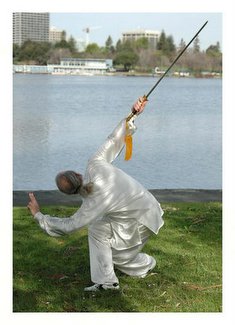
Oftentimes, skeptics (myself included) tend to fall into a frame of thinking on matters we can be severely uninformed on - to wit, we scoff sometimes too freely and easily, without taking the measure on a subject.
Case in point: I've been doing Tai Chi for well over a decade now. Most of you probably know what that is. What most people don't realize, is that it is a form of Qiqong, more specifically Nèijiā, a subset of Chi Kung.
(Quit rollin' yer eyes, the answer's not on the ceiling. No, it's not a cult, nor am I a 'wooster'.)
For the record, I don't 'believe' in acupuncture (tried it, didn't work), hypnosis (I'm too self-aware, apparently, didn't work either), Reiki, or any of those other wonky New Age placebos. I'm a firm proponent of 'if it don't work, scrap it'.
Let's cover the concept of 'Chi' briefly. Roughly translated, it means 'breath'. Holy crap, even Answers.com renders the translation in terms of woo! I interpret it thusly: it's your life energy. Bio-chemical neurotransmitters firing. Simple enough.
There's a plague (both here and in the Orient) where all the snake-oil salesmen (and women - SHEESH!) are jumping on the bandwagon, hoping to make a fast easy buck off the gullible. Hell, I've run into a couple (I attended a demo where this fellow claimed to be able to knock people over from a distance with his 'chi', but get this: IT ONLY WORKS ON HIS TRAINED STUDENTS! Talk about re-affirmed confirmation bias. Personally, I think he's fulla crap.) The New Age stoners borrow freely, and play mix 'n match to their little hearts' content.
Where's the double-blind studies, you ask? That's an impossibility in this case, since you have to actually perform said activity before an accurate measurement can be taken. But hold onto your hats: "Researchers have found that long-term T'ai Chi practice had favorable effects on the promotion of balance control, flexibility and cardiovascular fitness and reduced the risk of falls in elders. The studies also reported reduced pain, stress and anxiety in healthy subjects. Other studies have indicated improved cardiovascular and respiratory function in healthy subjects as well as those who had undergone coronary artery bypass surgery. Patients also benefited from T'ai Chi who suffered from heart failure, high blood pressure, heart attacks, arthritis and multiple sclerosis.
"T'ai Chi has also been shown to reduce the symptoms of young Attention Deficit and Hyperactivity Disorder (ADHD) sufferers. T'ai Chi's gentle, low impact movements surprisingly burn more calories than surfing and nearly as many as downhill skiing. T'ai Chi also boosts aspects of the immune system's function very significantly, and has been shown to reduce the incidence of anxiety, depression, and overall mood disturbance. (See research citations listed below.)
"A pilot study has found evidence that T'ai Chi and related qigong helps reduce the severity of diabetes.[2]"
There's more on this in regards to Qiqong - again, I repeat: don't take my word for it, research it for yourself. Better yet, just try it out for yourself. Proof's in the pudding, they say.
Let's take a few ganders at some of the information available:
"Criticisms of qigong
"Much of the criticism of qigong involves its claimed method of operation. Both traditional Chinese and Western medicine practitioners have little argument with the notion that qigong can improve and in many cases maintain health by encouraging movement, increasing range of motion, and improving joint flexibility and resilience. However, the benefits of qigong become much more controversial when it is asserted that qigong derives its benefits from qi acting as a kind of "biological plasma" that cannot be detected by scientific instruments. Many biologists and physicists are skeptical of these claims and regard them as pseudoscientific. The early shamanic aspects of qigong have added to this criticism. Some experts in China have warned against the more pseudoscientific or shamanic aspects of qigong, such as evoking demons, and worshipping deity forms during qigong, and to focus on the strengthening and stretching aspects instead."
I'm with the biologists and physicists on this one.
"Many proponents of qigong claim that they can directly detect and manipulate this energy. Others, including some traditional Chinese practitioners, believe that qi can be viewed as a metaphor for biological processes, and the effectiveness of qigong can also be explained in terms more familiar to Western medicine such as stress management."
I fall into the above category.
And of course, there's these items that fall well outside of the 'It's all good, dog!' category:
"Stories of unguided practitioners or inexpertly guided students developing chronic mental and physical health problems as a result of such training are not uncommon. A term used by English speaking practitioners and teachers for one example of this syndrome is "Qigong Psychosis" (Now included in the DSM-IV as a culture-bound syndrome: Qi-Gong Psychotic Reaction: DSM-IV General Information: Appendix I, Outline for Cultural Formulation and Glossary of Culture-Bound Syndromes). Another function of improper training involves frauds and deliberate charlatans who promote themselves as qigong "healers" promising miracle cures of any conceivable affliction for the right amount of money. Traditionally, qigong is considered more of a health maintenance regimen, and any promises of miracle cures should be viewed with suspicion, according to traditional teachers and practitioners."
I can indeed provide some proofs on this area. Qiqong (the garden-variety) is usually beneficial, it's not likely that if you do, say, the Wild Goose Chi Kung exercises, that you'll end up being Charley Manson. It's a fairly benign series of exercises. Just as there's a wide divergence between riding your bicycle in the park, and doing bicycle motocross.
But when you start doing bizarre breathing exercises without supervision like tortoise breathing, or reverse breathing, or even some of the sexual Chi Kungs (such as taught by Mantak Chia without being 'spotted', there's going to be some major adverse results. Kumar Frantzis recounts in his 'Opening the Energy Gates of the Body', that he did a White Crane chi kung that enabled him to break a brick with the slap of his hand. The unfortunate side-effect? He found that he began losing empathy, and that it was making him psychotic.
And think on this: breathing changes your physiology. Not radically (say, on a genetic level: that's just silly), but it impacts your emotional responses. When you panic and hyperventilate, a good cure is to inhale and exhale into a paper bag (for a more simplistic example).
On a personal level, I do Tai Chi far more often than I do a stationary form of Chi Kung. The stationary forms are difficult on a different level. It requires standing stock still, and emptying the mind, focusing on the breathing, and trust you me, that's way harder than it sounds.
So, to nutshell it: there is something to be said in regards these sets of exercises - learning to breathe properly, learning to let go of all the multiple stress factors of our day-to-day lives (if only a brief escape; who can argue with that?), teaching oneself to relax, and perhaps getting a bit of exercise and improving the circulation, that's all well and good.
But if some yobbo promises you supernatural miracles (such as Falun Gong), or make wild promises about how the practice will impact your life dramatically (daimoku), or some unsubstantiated unprovable crap about using their energy to impact your energy (Reiki), you have my permission to laugh loudly in their face, or they can just drop by here, and I'll be more than happy to drub them soundly.
And that, dear readers, is my nickel's worth: be careful how you spend it.
Till the next post, then.